
Representatives of the Limassol District Administration (EOA) will visit the abandoned village of Trosena in the coming days to verify whether the investor has complied with an order to suspend all construction activities being carried out without the necessary permits. The announcement was made on Wednesday, June 3, by EOA Director Yiannis Tsoloftas.
The inspection comes amid growing concern over a large-scale redevelopment project in the village, which is located within an environmentally sensitive area that forms part of the Natura 2000 network.
What Regulations Did the Investor Violate?
According to Tsoloftas, a previous inspection revealed several construction activities that were being carried out without the required planning and building permits. On May 25, 2026, the EOA sent the investor an official notice demanding the immediate suspension of all works requiring authorization.
A specific deadline was set for compliance, and officials are now returning to the site to ensure the order has been followed. In addition, in coordination with the Department of Environment, the project's architects have been instructed to prepare a comprehensive master plan covering the entire development. This approach will allow authorities to assess the project as a whole rather than in separate stages, making it easier to evaluate its environmental impact and legal compliance.
Who Is Behind the Project and What Is Planned?
The project is led by Uriel Kertes, a businessman holding both Hungarian and Israeli citizenship. According to Kertes, he discovered Trosena by chance in 2021 while searching for land suitable for development.
"I was driving along small roads, saw this place, and fell in love with it," the investor said.
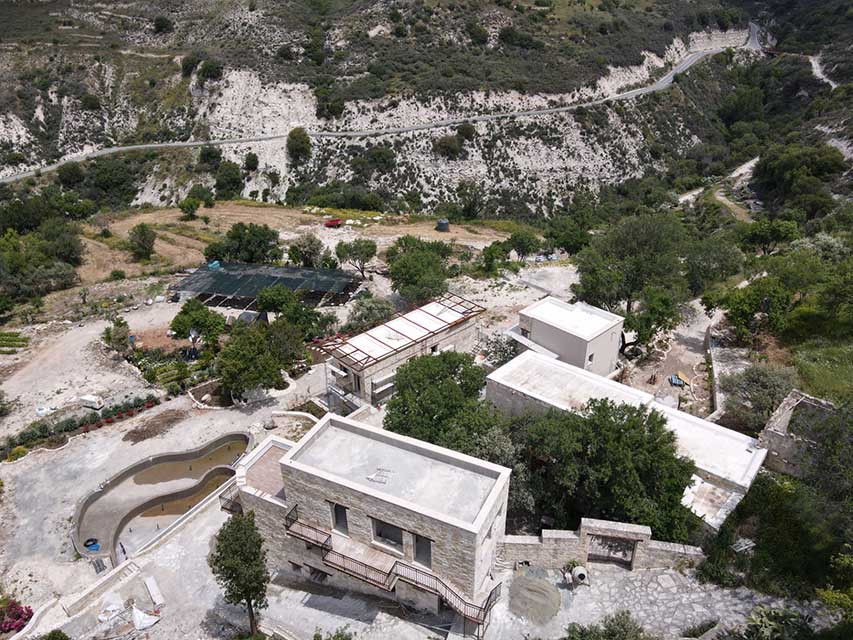
According to publicly available information, Kertes has acquired approximately 70–80% of the privately owned properties in the village center, reportedly investing between €2 million and €3 million. The scale of the project goes far beyond the "cosmetic restoration" many initially expected. Planning documents indicate that Trosena will be transformed into a tourism destination featuring a 64-room accommodation complex spread across 16 restored buildings, with capacity for up to 132 guests at a time.
In addition to accommodation facilities, the project includes a winery with its own vineyards, a large restaurant, a spa area, reception facilities, luxury glamping accommodation, and various wellness-related amenities. In essence, the development represents a full-scale resort complex presented as an eco-tourism project.
Why Has the Project Sparked Controversy?
The Trosena story has evolved beyond a simple construction dispute. In recent weeks, it has become the center of a broader public debate touching on foreign investment, environmental protection, public access to communal spaces, and national identity.
Social media has been flooded with claims that Israeli companies had completely purchased the village, restricted access to visitors, and that security personnel were describing the area as "Jewish land." Some residents also expressed concerns that the historic Church of Saint George could be demolished.
However, the Community Council of Arsos, Gerovasa, and Trosena has categorically denied these allegations. In an official statement, the council emphasized that the village remains open to all visitors and that any temporary access restrictions are solely related to construction-site safety requirements.
Local Residents See Potential Benefits
Arsos Community Leader Yiannis Yiannakis made a surprising statement in support of the project, describing it as "a response to decades of state neglect." According to him, Trosena was largely abandoned during the 1990s due to the lack of basic infrastructure, particularly electricity. Successive governments promised improvements but failed to deliver, ultimately contributing to the village's decline.
Yiannakis argued that the redevelopment offers an opportunity for economic and social revival not only for Trosena but also for neighboring villages facing similar challenges. Around ten families from Arsos have already found employment through the project, and more than 50 jobs are expected to be created once it is completed.
Given the vulnerability of the surrounding forest area and recent wildfire concerns, the investor has also committed to providing a dedicated fire engine for the region. Local authorities have further rejected claims regarding the church's demolition, noting that the investor is financing restoration works and improvements to the surrounding area.
Historical Background
Trosena has a complex history that adds further significance to the current controversy. The small Greek Cypriot village was never particularly prosperous and gradually became deserted during the late twentieth century, with its final residents leaving in the 1990s.
Historically, the Diarizos Valley contained two neighboring villages: Trosena, inhabited by Greek Cypriots, and Gerovasa, home to Turkish Cypriots. The villages were separated by a riverbed but connected by a bridge built during British colonial rule. Gerovasa was abandoned earlier, during the intercommunal conflicts of 1963–1964.
As a result, Cyprus has a long and often overlooked geography of abandoned settlements. Dozens of villages were deserted because of conflict, population displacement, economic decline, and urbanization. Today, the future of one such village has become a battleground between environmental protection, economic development, politics, and private investment.
What Happens Next?
The next stage of the story will depend largely on the outcome of the upcoming EOA inspection. If the investor has failed to comply with the suspension order, enforcement measures and administrative fines may follow.
At the same time, the Department of Environment has already completed its own assessment of the project. According to a document published on the department's website, "the proposed development is not expected to adversely affect the integrity or conservation objectives of the Natura 2000 Special Protection Area," provided that all mitigation measures are fully implemented.
The report even suggests that the project could contribute positively to environmental conservation by reducing uncontrolled access, illegal hunting, and unauthorized development within the area.
Nevertheless, given the public attention surrounding the project and the sensitivity of the Natura 2000 site, authorities are unlikely to allow the development to proceed without close oversight. The key question is whether the parties involved can strike a balance between economic development and environmental protection—or whether Trosena will become another landmark case with implications for all of Cyprus.