
The Limassol District Local Government Organization (EOA) has found itself in a paradoxical situation. On one hand, it is responsible for approximately 1,000 unsafe buildings, 40 of which have been classified as critically dangerous. On the other hand, current legislation provides the organization with very limited authority to act against owners of hazardous properties. EOA Director General Socrates Metaxas has openly stated that the organization requires expanded powers to quickly close buildings that pose a threat to public safety, even when property owners object.
Particular concern stems from the fact that much of the problematic housing stock was built between the 1960s and 1980s and has never undergone a comprehensive structural inspection. Many of these buildings were constructed using sea sand, which over time has led to corrosion of reinforcing steel and deterioration of load-bearing structures.
What Powers Does the EOA Need to Protect Residents?
Under current law, responsibility for a building’s condition rests with its owners. In practice, however, many property owners ignore official notices because enforcement mechanisms remain limited. According to Metaxas, the EOA needs the authority to disconnect dangerous buildings from electricity and water supplies, as well as order mandatory evacuations of residents. Without such powers, the organization is forced to pursue lengthy court procedures, even in situations where urgent action is required.
Similar challenges exist in other regions of Cyprus. In Larnaca, for example, more than 500 potentially dangerous buildings have been identified, while Paphos has recorded 226 unsafe structures. Authorities in Larnaca have already proposed stricter penalties for negligent owners, including fines of up to €20,000 and prison sentences.
What Changed After the Germasogeia Building Collapse?
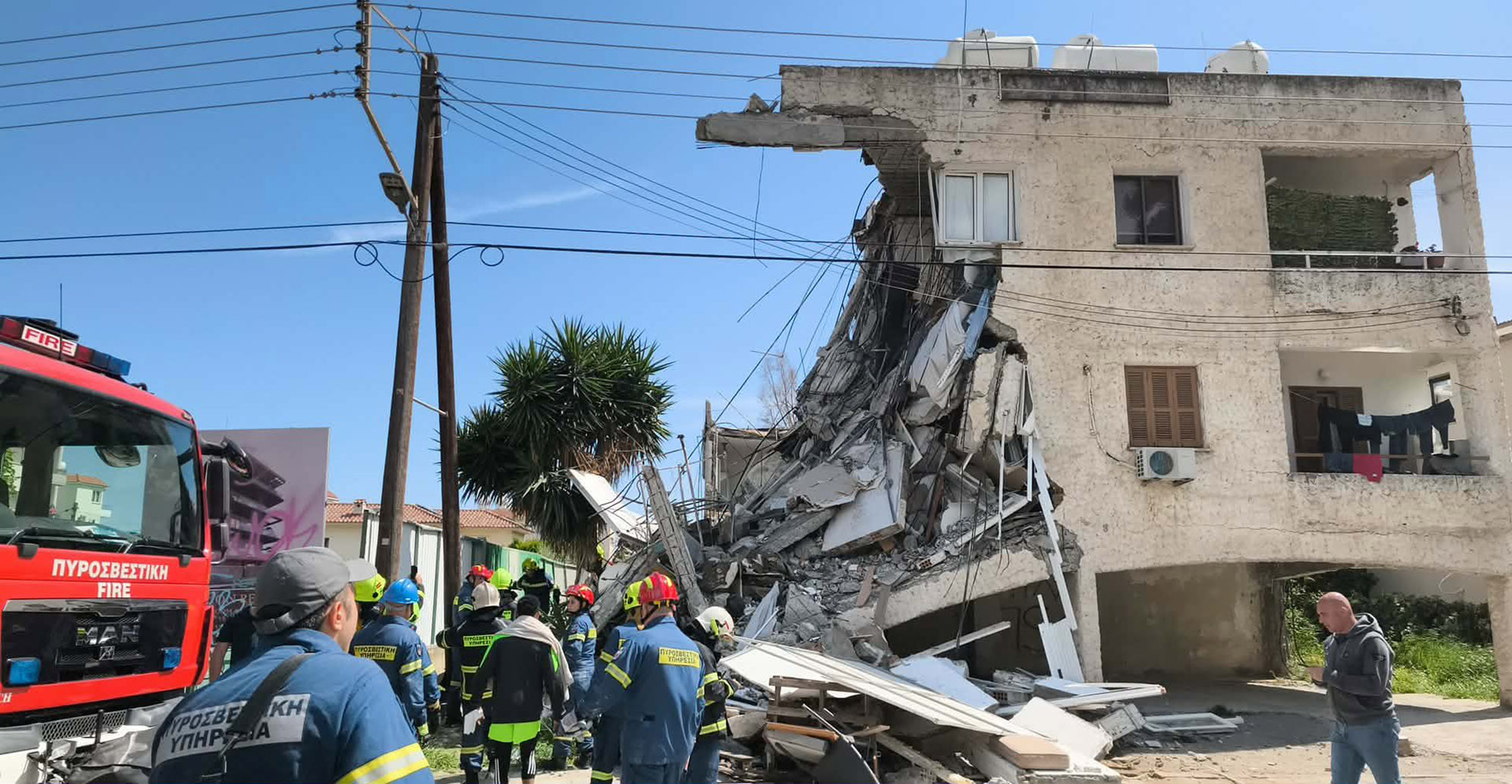
The tragedy that occurred in Limassol on April 11, 2026, became a turning point. A residential building in Germasogeia that had previously been declared unsafe collapsed, claiming the lives of two people. Many surviving residents, including foreign workers, lost not only their homes but also their documents and savings.
Subsequent investigations revealed that the building’s owners had been receiving warnings since as early as 2017.
Following the disaster, authorities across the island launched emergency inspections of older residential buildings. It was also revealed that approximately 15,000 new applications for building amnesties had been added to an existing backlog of 30,000 unresolved cases. The situation is further complicated by the fact that neither municipalities nor district organizations are willing to assume financial responsibility for demolishing unsafe buildings.
A Law That Could Save Lives
Back in March 2025, Cyprus’ Ministry of Interior submitted draft legislation to Parliament that would grant District Organizations additional powers. The bill, prepared with input from members of Parliament, proposes simplifying owner notification procedures, allowing authorities to obtain unilateral court orders for evictions, disconnect utilities, and seal dangerous buildings. It also proposes increasing fines for non-compliance to as much as €40,000.
However, the bill has remained under consideration for more than a year. Local media have noted that had the legislation been adopted before the Germasogeia tragedy, the loss of life might have been prevented. Residents of the collapsed building had been given three months to vacate the premises, until June 26, 2026, but the structure collapsed just three weeks after the notice was issued.
How the Limassol EOA Operates and What It Has Achieved So Far
The Limassol District Local Government Organization was established on July 1, 2024. It assumed responsibility for water supply, sewerage services, waste management, and building permit administration. Upon its creation, the organization inherited approximately 700 dangerous buildings from previous authorities, but subsequent inspections increased the total to around 1,000.
Regarding building permits, the EOA also inherited approximately 8,500 unresolved applications. To date, it has processed around two-thirds of this backlog. Metaxas has set a goal of clearing all remaining cases by the end of the year and transitioning to normal operating procedures. The organization’s workforce is expected to expand to approximately 500 employees by year-end.
The Construction Boom in Limassol Continues
Paradoxically, while concerns over unsafe buildings continue to grow, construction activity in Limassol remains among the strongest in Cyprus. Authorities receive approximately 1,000 new building permit applications every month. Most originate from Moni, Parekklisia, and Episkopi and primarily involve apartment complexes, high-rise residential buildings, and towers.
Investor interest in large-scale residential developments remains particularly strong along the Aktea coastal road area. However, the city does not have a dedicated skyscraper district; each project is assessed individually based on legislation, local conditions, and infrastructure capacity.
The safety of aging residential buildings is now regarded as one of the most serious challenges facing Cypriot authorities. Experts believe that solving the problem will require substantial financial investment as well as the political will to implement long-overdue legislative reforms.
Amathus Mayor Kyriakos Xydias has urged authorities to focus less on assigning blame and more on preventing future tragedies. According to him, Cyprus needs a mandatory registry of apartment buildings, regular structural inspections, and immediate criminal liability for owners who refuse to evacuate residents from buildings deemed unsafe.