An individual who receives income in Cyprus or from Cyprus is required to pay taxes. This can be done online, without visiting the Tax Department or hiring specialised professionals. In 2026, tax returns are still filed through TAXISnet, but you also need to have a personal account in Tax For All. Below, we explain in detail how not to get confused and how to manage the process if you are filing a tax return for the first time.
Who needs to file a tax return in Cyprus
There are two categories of people who pay taxes in the country:
- Tax residents. You can quickly read more about who qualifies and what the “60/183-day rule” means in our article. They pay taxes and other contributions on their total gross income, which in Cyprus is referred to as gross income.
- Non-residents who receive income in Cyprus, for example through employment or remote business activities. A non-resident may not live on the island, but must still pay tax on Cyprus-source income. This point should be examined carefully because citizens of some countries, including Russia, may in such circumstances be taxed twice: in their home country or country of residence and in Cyprus.
In 2026, those who received income in Cyprus in the 2025 tax year must file a return. It is important to clarify that this refers specifically to the TAX year. In 2025, the tax year coincides with the calendar year.
Residents whose total annual income did not exceed €19,500 are exempt from income tax. They do not need to file a tax return — but this is the last year when this is possible. Next year, meaning for the 2026 tax year, a return will have to be filed even if the person owes no tax, provided they are nevertheless a Cyprus tax resident.
Income on which tax may be payable includes:
- salary and pension income;
- self-employment or business income;
- capital gains;
- income from renting out property in Cyprus;
- dividends and other passive income.
Important! Reliefs, discounts and deductions may apply to all of the income sources listed above. Each case should be examined separately.
You may also need to pay:
- Special Defence Contribution, but only for domiciled residents;
- GESY, the contribution to Cyprus’s healthcare system — 2.65%.

Two online platforms: how not to confuse them
In 2026, Cyprus taxpayers have two main online platforms. The most difficult part is not confusing them, because they currently serve different functions while still being interconnected.
- TAXISnet — the platform for individuals to file income tax returns. According to the government, it will remain in use until 2027. Website: https://taxisnet.mof.gov.cy.
- Tax For All (TFA) — a platform intended to bring together all tax-related actions and payments for individuals and organisations, as well as taxpayer registration. In 2026, VAT is handled through it. From next year, the authorities plan to accept all documents through the platform, including tax returns from individuals. Website: tfa.tax.gov.cy.
In practice, in 2026 a taxpayer needs accounts on both platforms. The good news is that registration only needs to be completed once — through TFA.
The easiest way to understand the process is through the following table:
What to do | TAXISnet | Tax For All |
Register as a taxpayer and obtain a TIC (tax identification number) | Online, or in exceptional cases in person through the Tax Department | |
Declare VAT | Here | |
Declare individual income tax using form TD1 for 2025 in 2026 | Here | |
PAYE (Pay As You Earn), where the employer transfers the employee’s income tax directly to the tax authorities | Here |
Procedure for new residents
So, you are going to pay taxes in Cyprus for the first time. Relax, take a moment, and look at the order in which you need to proceed. None of it is particularly difficult and the process is actually quite transparent. The most important thing is to have all the necessary documents ready.
The procedure is as follows:
- Register with the tax authorities and obtain a TIC, also known as a TIN or tax identification number.
- Register for a taxpayer account — as explained above, this is done through Tax For All.
- Complete verification in Tax For All.
- Activate your profile.
- Apply for Non-Domicile status.
- Register with GESY.
- Gather all documents confirming your income.
- Log in to TAXISnet and complete form TD1. Do not forget the forms related to Non-Domicile status.
- Wait for the review and correct any errors if necessary.
- Pay the taxes due.
Existing residents essentially follow the same procedure, starting from step 7. The entire process takes less than an hour, provided everything is double-checked before pressing the Submit button.
Tip: these services work better on a computer, as the mobile versions can be unstable.

How to become a taxpayer in Cyprus: documents required for a TIC
The Taxpayer Identification Code, or TIC, is essentially the Cyprus equivalent of a tax identification number. You do not need to go anywhere to obtain it — all documents can be submitted in PDF or JPG format, provided they are clearly readable. The standard set includes:
- passport;
- temporary or permanent residence permit in Cyprus;
- employment contract, self-employment documents or proof of business ownership — anything showing where the taxpayer’s income comes from;
- proof of permanent residence in Cyprus, such as a title deed or long-term rental agreement; hotel accommodation or short-term rental will not qualify;
- a Cyprus phone number and email address;
- documents for filing a joint return, for example a marriage certificate; if it is in Russian, it must be translated and notarised.
Then follow these steps:
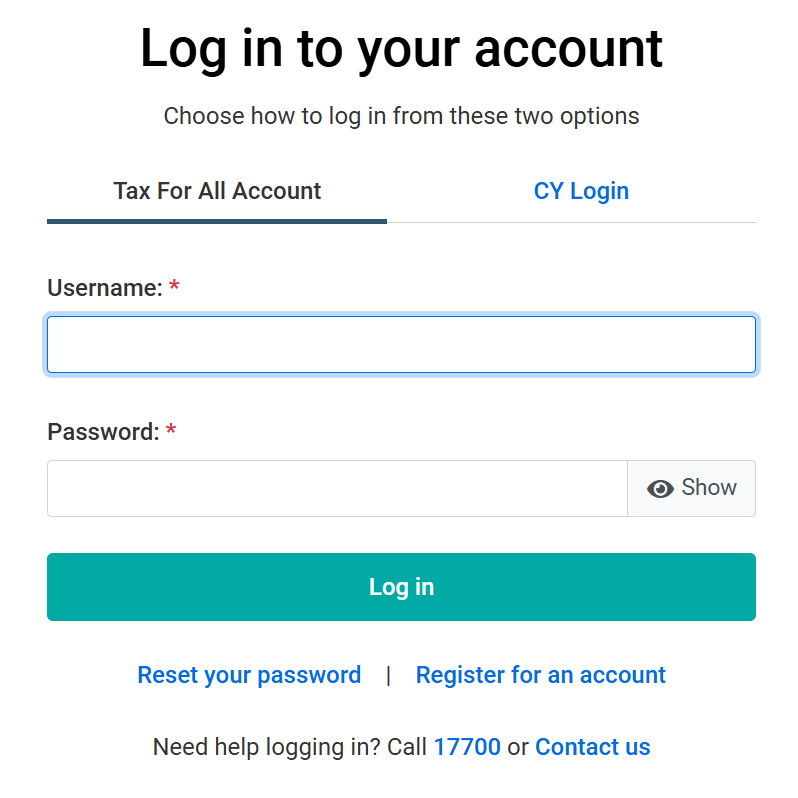
- Register on Tax For All and indicate that you do not yet have a TIC.
- Choose your employment type: Individual if you work for someone else, or Self-Employed.
- Choose your status: Resident or Non-Resident.
- Complete the application and check that every detail, right down to each letter, matches across your passport, residence permit and other documents.
- Upload the files listed above.
- Confirm your email and phone number and use them to complete verification.
- Submit everything for review and wait until your TIC appears in your account and is sent by email. Sometimes this can take up to a month, so it is better to start as early as possible in order not to miss the tax return deadline.
In some cases, a TIC can only be obtained by visiting the Tax Department in person. For example, this may happen if your name is spelled differently across your documents (for instance, Valerevna is not the same as Valerievna or Walerevna).
How to complete the TD1 tax return: 7 steps
It will probably be easier to complete the fields on the website after switching the interface to English. This can be done in the top-right corner. A browser’s automatic translation feature can also translate the website into Russian quite easily.
Step 1. Gather all documents
- IR63 certificate from a Cyprus employer, if applicable;
- rental agreement if you rent out property;
- bank statements;
- statements from payment systems such as Wise, Revolut, Mellow and others;
- completed T.D.38QA form confirming Non-Domicile status;
- proof of GESY and social insurance contributions, with the latter applying only to people employed in Cyprus;
- a calendar showing the number of days spent in Cyprus and, if necessary, airline tickets to verify the exact dates of stay and how to calculate them;
- documents supporting any tax deductions you intend to claim.
Step 2. Log in and open the return
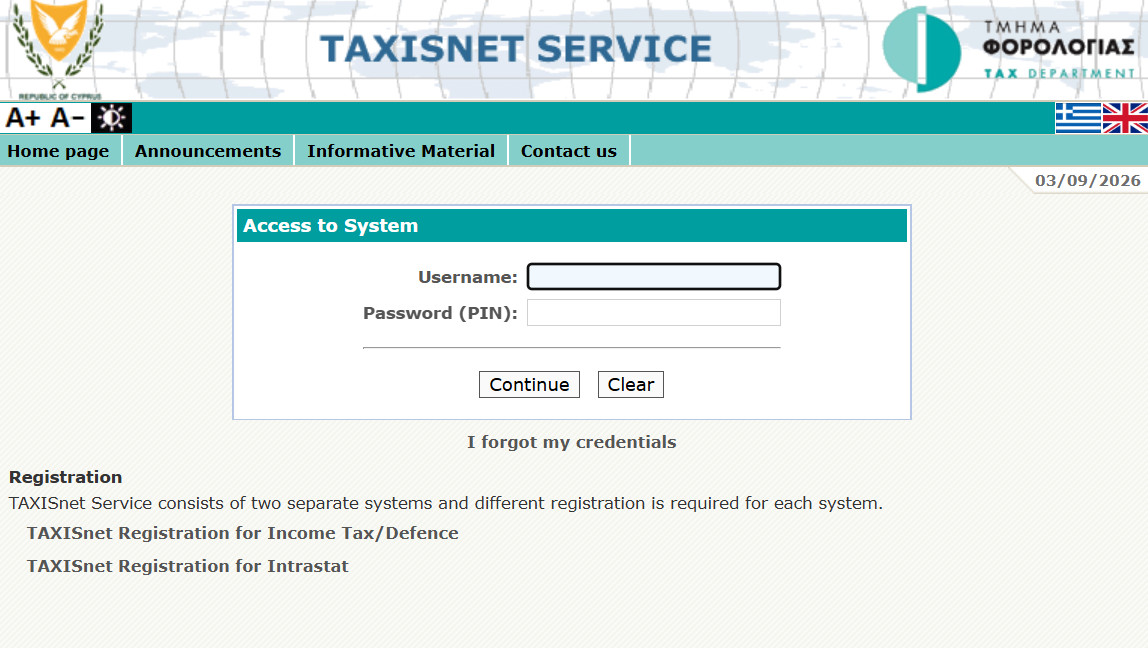
- Log in to TAXISnet.
- Choose the type and year: Income Tax Return of Individual for 2025.
- Do not forget to tick the boxes for tax residency and Non-Domicile status.
Step 3. Declare income
- Employment — income from your employer based on the IR63 certificate; if you had several employers during the year, use a separate line for each one.
- Rental income.
- Dividends and investment interest, even if they are tax-exempt.
- Foreign payments, including pensions from other countries.
- Cyprus pension.
Step 4. Enter tax deductions and reliefs
The following may qualify for tax deductions:
- GESY contributions;
- charitable donations and trade union contributions;
- housing rent or mortgage expenses;
- life insurance;
- 20% of gross rental income;
- expenses related to environmentally friendly technologies, such as installing solar panels or purchasing an electric vehicle;
- 20% to 50% relief for expatriates with annual income from €55,000, among other reliefs.
Step 5. Check the automatically calculated tax
The system will calculate the tax automatically. At this stage, you can spot inconsistencies and correct them. There is an Amend Personal Details button for changing figures or personal information.
Step 6. Check the return before submitting it
- all personal details are correct;
- the correct reporting year and residency status are selected;
- there are no empty fields;
- the intermediate figures from your documents match the figures entered in the fields;
- the final amount looks reasonable and corresponds to calculations made manually in advance;
- if something does not add up and you cannot understand why, it is better to postpone filing and hire an accountant who can complete the calculations for you.
Step 7. Submit the return and save the confirmation
If everything adds up neatly, you can press Submit. Be sure to save the generated document as a PDF, as it may be useful if the tax authorities later disagree with your return.
Important! It is better to save your progress every 5–10 minutes because the system may reload.

Filing deadlines and penalties in 2026
In 2026, the government opened the filing period later than usual and, accordingly, will close it later. Individual tax returns for 2025 must be filed between 19 June and 31 October 2026 inclusive.
The penalty for late filing is €100–150, while failing to obtain a TIC despite receiving income may result in a €100 penalty. Late tax payments may also attract interest of up to 5% of the amount due. The most severe penalty is a 100% surcharge for concealing income or deliberately understating tax liabilities, together with possible court proceedings.
Important! For people without Cyprus citizenship, court proceedings can always potentially result in deportation.
Conclusion
Filing a 2025 tax return through TAXISnet is not particularly difficult, even if you are doing it for the first time and your English or Greek is not strong. The main issue is that 2026 is the final year in which this can be done through this platform. From 2027, everything will move to Tax For All.
Read also:
- Lefkaritika: Cypriot Lace That Conquered the World and Became UNESCO Heritage
- Taxis in Cyprus: Apps, Prices and How to Book
- Winter in Cyprus: Does It Snow and How Cold Does It Get?
- Top 10 New Developments in the Government-Controlled Areas of Famagusta Due for Completion in 2026
- Top 10 New Developments in Paphos Due for Completion in 2026