In most businesses, losses from design do not look like losses. They look like routine operations: a slightly lower average check, extra minutes in processes, customers who do not return. This is a loss of efficiency that has no obvious cause in reporting.
When a business calculates the budget for opening a new space, design usually falls into the “cut” category. This is because there are expenses for construction, equipment, staff — and then there is design, which seems less important. But in reality, design determines how everything else will function. And mistakes in it do not disappear after project completion — they become part of the daily operational reality of the business.
 Space as a business tool, not just an interior
A commercial space is an environment that either strengthens the operational model or works against it. An office where coordination is difficult, a retail space where the customer does not understand where to go, a medical facility where a patient feels anxious even before seeing a doctor — these are not just issues of style, but of movement logic, zoning, and usage scenarios. The consequences of poor design decisions are reflected in space utilization, processes, user behavior, and ultimately in financial results. Once the space is launched, these issues are difficult to fix.
The first place where design mistakes become noticeable is construction. A well-thought-out project anticipates potential conflicts in advance: where communications run, how structures interact with finishes, and how different contractors work simultaneously. In a weak project, these issues are resolved on-site, leading to delays, rework, and additional approvals. From experience, fixing an error during construction costs 5–10 times more than fixing it at the design stage. Scaled to the size of a project, this easily outweighs any savings on design.
 Design mistakes: from construction to daily losses
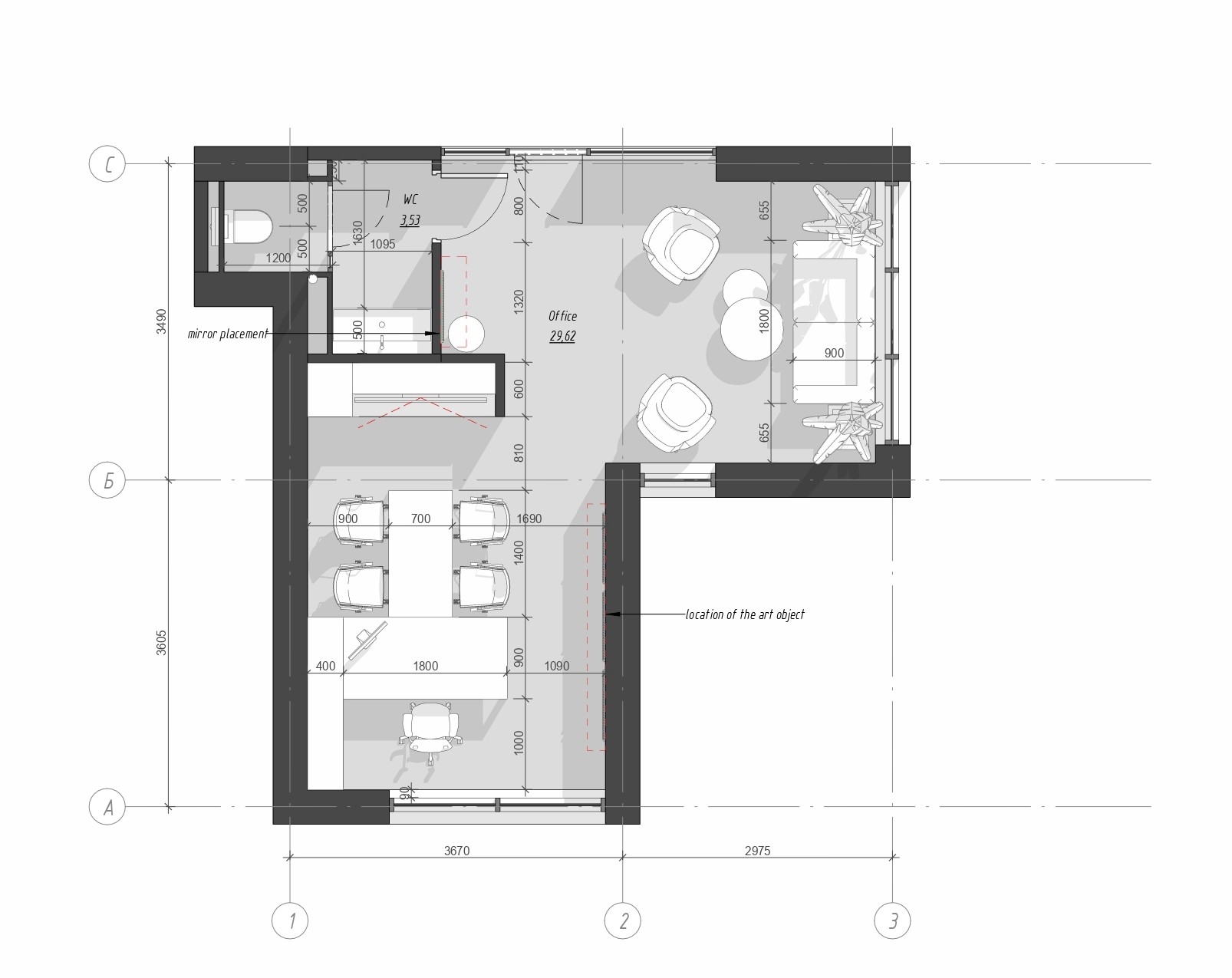
But construction is a one-time cost; daily operations after opening are far more expensive. Take an office, for example. Layout affects how much time people spend moving, searching for meeting rooms, and coordinating between departments. This is not immediately perceived as a problem: a person just takes an extra step or waits an extra minute. But if a team of 50 people each loses 10 minutes per day due to poor layout, that’s more than 40 hours of team time per month — constant, invisible, but very real costs. In this way, poor layout can reduce efficiency by up to 10–15%.
In retail, the mechanics differ, but the logic is the same. Customer flow is shaped by layout, zoning, shelf height, and lighting direction. When designed correctly, customers move more, see more, and buy more. When not, they shorten their path, pick what they see immediately, and leave. In one case, we redesigned a retail space without increasing its size: we changed movement logic and zoning. The commercially active area increased by 15%, and revenue grew by 12% in the first three months. This is a business effect that cannot be achieved through aesthetics alone.
There is another factor that is rarely included in technical briefs and is harder to measure but easy to feel. People react physically to space: noise levels, light quality and temperature, sense of scale, and presence of orientation cues. These factors influence how long a person stays, how relaxed they feel, and how ready they are to make decisions. In retail, this affects impulse purchases; in offices, the outcome of meetings; in medical facilities, patient anxiety levels. People simply feel uncomfortable and choose another place next time.
 How proper design affects profit
The necessary logic can be built into the project intentionally. But for this, design must anticipate how the business will function in the space. A quality project does not begin with style choices. A design brief is not a list of preferences about materials or colors — it is a document about the business: how many people work there, how customers move, how the sales process works, what scenarios are typical, and which are exceptions. Without this, you are designing an interior, not a business environment.
In today’s reality, mistakes are becoming more expensive. Construction material prices are rising, there is a shortage of skilled contractors, and timelines are getting longer. In such conditions, “we’ll fix it later” is not a viable strategy. Therefore, when choosing a designer, the real question is not “how much does the project cost?” but “how much will a mistake cost?”
A space designed around the operational logic of a business pays for itself. A space designed purely for visual appeal creates ongoing expenses that must be paid every day.
So how much does “cheap” design really cost? In practice: corrections during construction cost 5–10 times more than fixing mistakes at the design stage. Inefficient office layouts can waste up to 10–15% of team working time each month. Poor retail logic can mean losing the very 12% of revenue that could have been earned from day one. Saving $5,000–$10,000 on a project can easily result in six-figure annual losses, spread across small, barely noticeable expenses.
Read also: