
Construction of the new Archaeological Museum in the Cypriot capital is progressing at a rapid pace. Recently, the developer organized a guided tour of the construction site for local journalists, revealing fresh technical details about this landmark project.
Architecture Floating Above the City
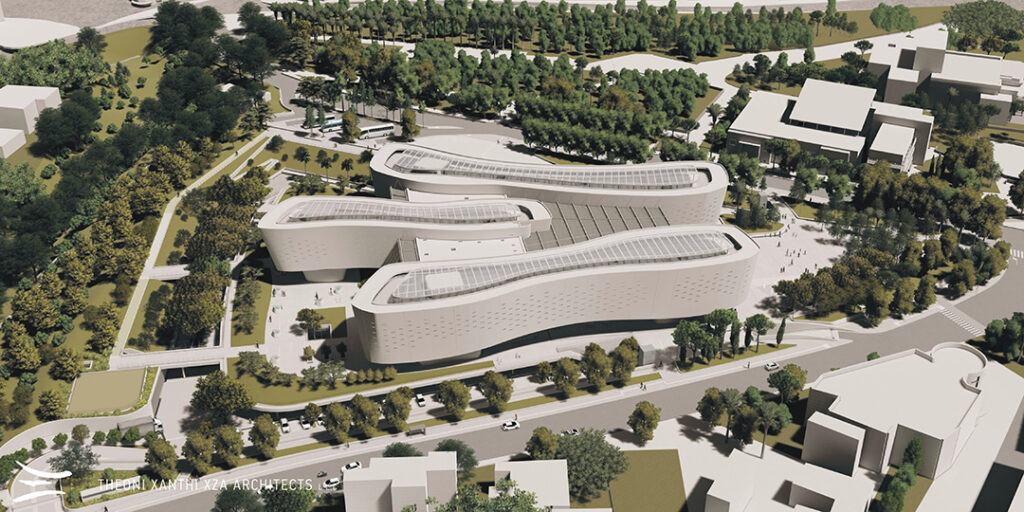
The central concept developed by architect Theoni Xanthi of XZA Architects, the winner of the international design competition, is the creation of an elevated museum structure. The nearly 40,000 m² building is being constructed directly beside the Pedieos River and will consist of five levels. Two floors will be located underground, while the three above-ground exhibition volumes will bear the symbolic names “Place,” “Sea,” and “World.” The lower part of the complex will remain free of construction, creating a spacious public square with greenery, seating areas, and unrestricted public access. This design effectively returns part of the site to the city, transforming the museum into an open and welcoming environment.
The most impressive technical feature of the project is its seismic protection system. The museum will literally float on 77 specially designed seismic isolators. In the event of an earthquake, each isolator can move up to 15 centimetres in any direction, effectively absorbing vibrations and protecting priceless artefacts. This technology is being used for the first time in Cyprus on a cultural heritage project of this scale. By comparison, conventional buildings do not possess such flexibility and may suffer critical damage during strong earthquakes.
Impressive Numbers: From Concrete to Wooden Mosaics
The construction of the museum complex is a remarkable engineering achievement. The excavation alone involves approximately 200,000 m³ of earth. Around 85,000 m³ of specially formulated concrete is being used for the walls and structural slabs. Yet the most remarkable details are found in the interior design. More than one million unique wooden elements of varying geometries will be installed on the ceilings and floors, with each piece individually manufactured. The floors will feature 10,000 m² of hand-cast mosaic work, while curved wooden surfaces will cover a further 6,500 m². For visitor convenience, the building will contain 17 elevators, while 20 fire curtains will enhance safety for both visitors and exhibits. The museum will also house 500 specialized display cases for artefacts and approximately 1,000 custom-made exhibition supports.
Beneath the upper exhibition levels will be a range of essential facilities designed to make the museum a fully self-sufficient cultural centre. These include temporary exhibition halls, modern conservation laboratories occupying 2,000 m², and vast storage facilities covering approximately 5,000 m². The project also includes educational classrooms, a café, a full-service restaurant, a gift shop, and underground parking. Around 150 specialists from 22 different professions work on-site every day, ranging from seismic engineers to mosaic craftsmen. The project is being delivered by the Iacovou – Cyfield Joint Venture consortium.
Sustainability and a New Life for Ancient Treasures
The developers describe the future museum as a facility with an almost zero carbon footprint. Advanced energy-saving systems, water recovery technologies, and natural ventilation solutions are expected to minimise environmental impact. At present, it is the most significant cultural infrastructure project under construction in Cyprus. However, as the project team emphasizes, its ultimate success will be measured not only by architectural excellence but also by its ability to stimulate public life, inspire scientific research, and bring archaeology closer to ordinary citizens. The opening of the new Archaeological Museum in Nicosia has the potential to transform the Cypriot capital into one of the leading cultural destinations in the Eastern Mediterranean.