
In an era when city boundaries are expanding, new buildings are getting taller, and rental prices are reaching unimaginable heights, the concept of housing seems to have lost its former stability and familiar meaning. In the modern urban landscape that has been taking shape in recent years in metropolises around the world — including Cyprus, Greece, and other European countries — having a roof over one’s head has ceased to be a guaranteed benefit and has turned into a real challenge. It was amid this chaos that, several years ago, a trend emerged in Japan and quickly became global: tiny apartments, that is, ultra-small flats that hold a minimum of belongings but still contain an entire human life. In other times, one might have said that this trend was born thanks to romantic fans of minimalism, as a counterweight to hyper-consumption. Today, however, tiny apartments — like other housing models that appeared after them — are a necessity that shows living conditions are changing.
Tokyo shrinks people in order to survive
If there is a country or, more precisely, a city that embodies the present and future of small-format housing, it is Tokyo. There, micro-apartments of just 9 m2, known as kyōshō jūtaku, are not a rare exception but a stable norm. These are spaces where the “tour” ends almost as soon as it begins: you enter and, with one step, find yourself simultaneously by the bed, in the kitchen, and at the doorstep. Kazuki Hirata, 29, who lives in such micro-housing in Sapporo, the capital of Hokkaido, explains: “During the first week, I felt like I was living in a box. Then I got used to it. There is something comforting about such a tiny space — you control it completely. And if you want to see people, the whole city is waiting outside the door. Why sit at home?” Today, occupancy of such apartments in Tokyo reaches 98%, especially among young people aged 20 to 35.
Cyprus: necessity, ingenuity, and new housing models
In Cyprus, the housing crisis has also triggered a shift toward smaller living spaces, although the country has not yet reached the trend of ultra-small apartments seen in Japan. Instead, demand has led to the emergence of new, fairly inventive, and much more economical solutions. These include prefab structures and homes made from shipping containers. Young people are gradually moving away from loans and looking for flexibility, affordability, and security. In this context, completely original approaches are also emerging. For example, a local resident named Alexander converted his 3-bedroom apartment in Limassol into a dormitory exclusively for women.
According to him, the idea was born when his friend from London could not afford to pay for housing alone and began renting out rooms in his apartment. After hearing this, Alexander realized that there was a similar need in Cyprus as well, most often among girls who are concerned not only about finances but also about their safety. So he completely renovated his apartment, installed showers in each room, added small kitchens, and created an additional shared space — a living room. Today, he rents the apartment only to girls. The rental rules are strict: women only, respect for privacy, and clean common areas.
I have been renting out my apartment for several years, and it has not been empty for a single day. All the tenants are foreign women starting from scratch in Cyprus, and they always say they feel safe here. That is the most important thing, Alexander shares.
For his part, engineer-architect Giorgos Vasilakis believes that micro-apartments should not be seen as the result of evolution, but rather as a product of necessity, which in many cases worsens a person’s quality of life.
Architecture can deal intelligently with small scale, but this trend was born solely because of the very high cost of housing, Vasilakis notes.
In his opinion, Cyprus will not see extreme solutions like those in Japan, but the trend is obvious: apartment sizes are decreasing. Minimum size requirements have become more flexible. Developers are sacrificing spaces such as dining rooms in order to reduce the overall price. The architect does not support this trend, but understands that it is necessary in today’s reality.
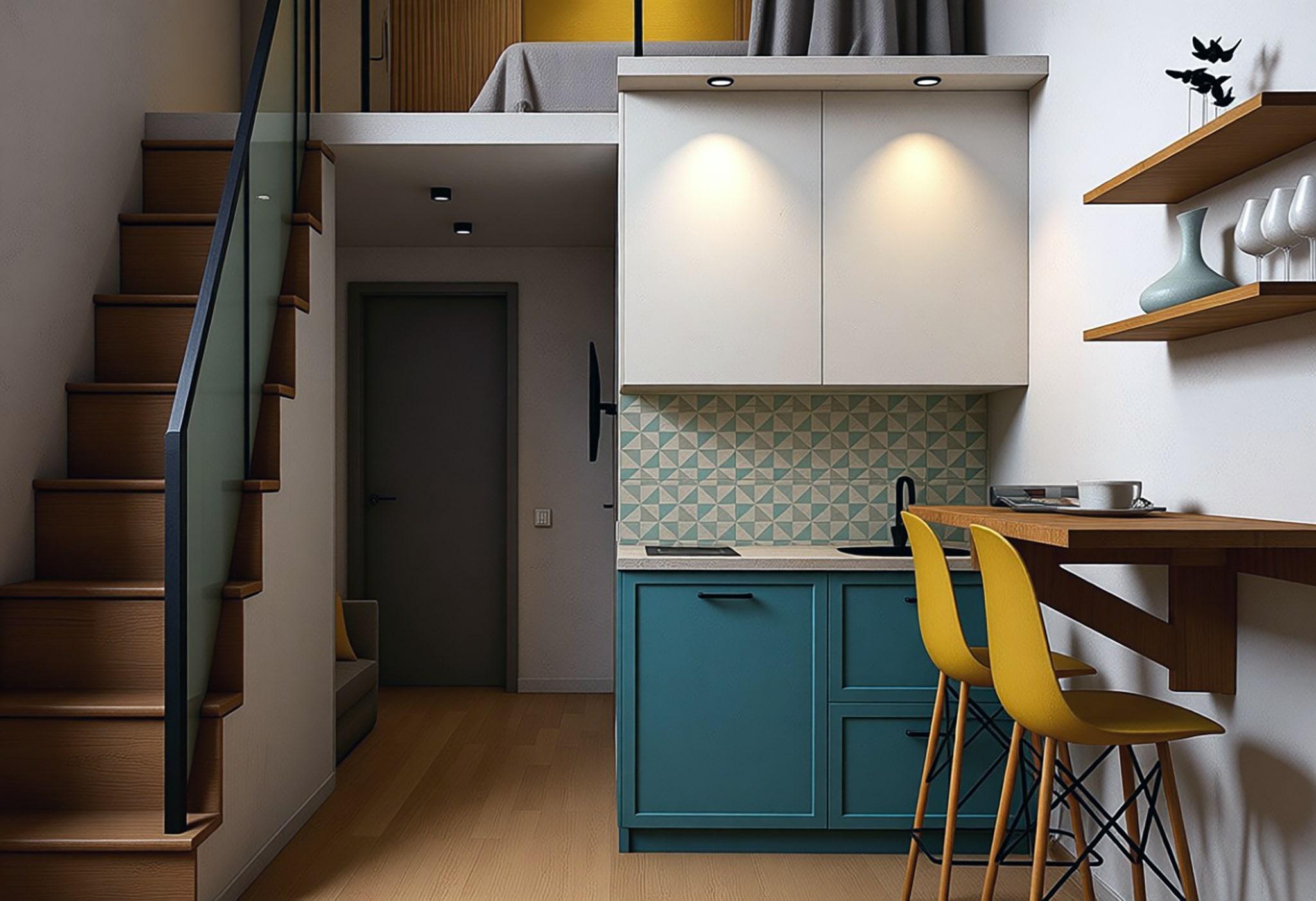
He describes designing an ultra-small apartment as both a challenge and a limitation, since in very small spaces every centimeter must work. Built-in storage, multifunctional furniture, proper lighting, and the use of height are needed. Detail becomes the main character. But Vasilakis also sees the downside: no matter how smart the design is, quality of life suffers. A person needs space, even if they do not admit it.
Speaking about future trends, the architect mentions modular structures, new-generation student residences, co-living models, smart homes with low energy consumption, and buildings that can be adapted to new needs in the future.
I believe these models are an architectural response to a society that is changing faster than homes are being built.
Europe: the same story
A similar picture can be seen in major European capitals, where the housing crisis has worsened due to overtourism and short-term rentals (Booking, Airbnb, and other services), leading to a sharp rise in prices. In Berlin, Madrid, and Paris, rents have increased by as much as 40% in recent years. In response, a new category of housing has appeared — micro-apartments ranging from 14 m2 to 20 m2, aimed mainly at young professionals, students, digital nomads, and those changing their life path.
Unlike Tokyo, in Europe the choice of ultra-small housing has turned into an entire philosophy: many say they prefer collecting experiences rather than things. They do not live inside the apartment, but outside it, and see a tiny studio not as a lack of comfort but as a ticket to urban life. But behind this philosophy there is often a silent admission: if they could, they would choose a larger space. However, people prefer to embellish reality rather than face it — perhaps as protection from the harsh urban truth.