
The Ammochostos Stadium in Larnaca, which has served as the home ground of Nea Salamina Famagusta FC for more than 30 years, is preparing for the largest reconstruction project in its history. The Cypriot authorities have officially approved a modernization plan that aims to transform the aging municipal stadium into a modern European-level football arena.
The project, valued at approximately €16 million, has already received approval from the Department of Environment. Funding will be provided by the Cyprus Sports Organization (KOA). Construction is expected to take place in four phases and last around two years.
Project Details
The stadium is located along Yiannos Kranidiotis Avenue in a densely populated part of Larnaca. The arena was originally built in 1992 and has undergone very little large-scale modernization since then. Today, the facility no longer meets modern standards for safety, comfort, or television broadcasting, making renovation a necessity.
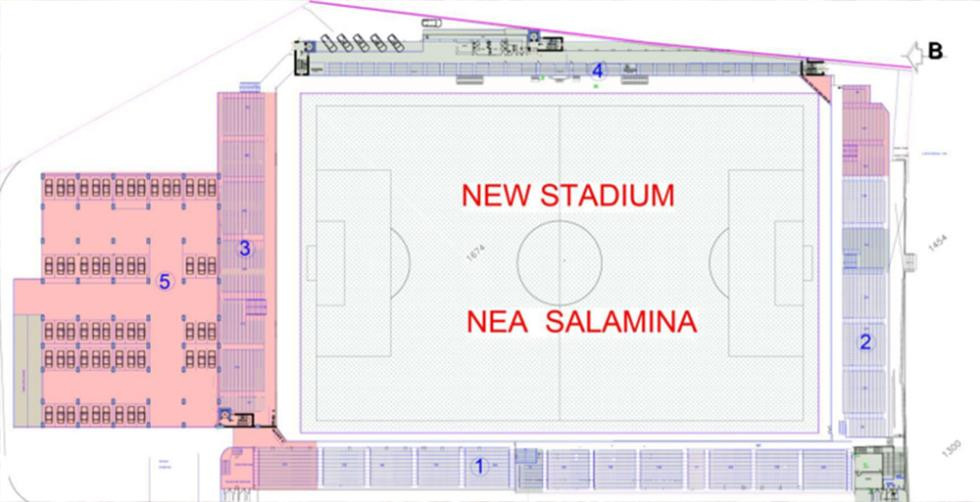
After completion, the stadium’s capacity will increase from 4,050 to 6,091 spectators. All seats will be fully covered, and the field will be visible without obstruction from every stand. Special areas for people with disabilities will also be introduced, along with new elevators, ramps, and adapted sanitary facilities.
The project also includes a major expansion of infrastructure. The arena will feature modern VIP boxes, hospitality areas, upgraded press centers, and new broadcasting facilities. Journalists will receive dedicated working spaces equipped with internet access, interview zones, and camera platforms designed according to UEFA standards.
New Technologies and Solar Energy
One of the most visible elements of the reconstruction will be the construction of a large roof covering the stands. Solar panels are expected to be integrated into the roof structure, helping the stadium partially generate its own electricity through renewable energy sources.
The stadium lighting system will also be completely replaced. The new LED lighting complex will comply with international requirements for HD and 4K broadcasting. Lighting levels will exceed 1,200 lux, allowing the venue to host evening matches and international tournaments. In addition, the stadium will receive a modern sound system, an electronic video screen, new access-control systems, and surveillance cameras. Entrances will be equipped with turnstiles and an electronic ticketing system with barcode scanning.
Comfort and Safety for Fans
Special attention in the project has been given to spectator comfort. Toilets, service points, relaxation zones, and the surrounding stadium areas will all be upgraded. Plans also include a reorganization of parking facilities and movement flows for spectators, teams, journalists, and VIP guests.
In total, the project includes the creation of 287 parking spaces, including dedicated areas for people with disabilities. Some parking spaces will be located adjacent to the stadium, while others will be placed on nearby land plots. Safety will also become one of the central elements of the modernization. In addition to a CCTV system, the arena will feature controlled entry zones and separate movement routes for supporters of different teams, which is especially important during high-risk matches.
Larnaca Continues Its Sports and Infrastructure Development
The stadium reconstruction forms part of Larnaca’s broader construction and infrastructure boom. In recent years, the city has been actively modernizing public spaces, sports facilities, and tourism infrastructure as part of preparations for the European Capital of Culture 2030 initiative.
The renovated stadium is expected to become not only a home arena for football matches but also a multifunctional venue for sporting and public events. Authorities hope that after reconstruction the facility will be capable of hosting international competitions and large-scale events, attracting additional visitors to Larnaca.