
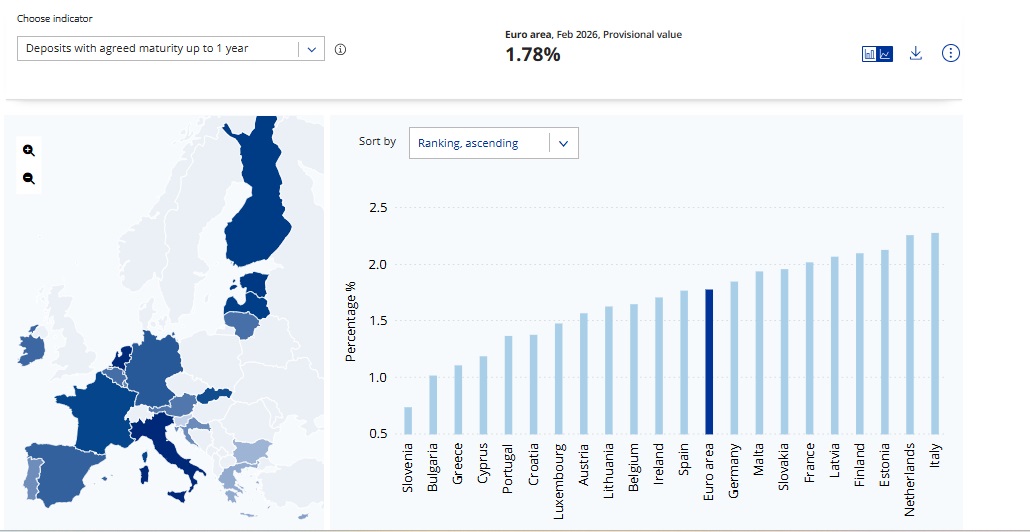
Cyprus has recorded another decline in deposit interest rates for both households and businesses. According to data from the European Central Bank, in February 2026 the rate on term deposits with a maturity of up to one year for households decreased to 1.19%, compared to 1.2% a month earlier. For comparison, in February 2025 this figure stood at 1.51%.
Despite the modest monthly change, the overall trend remains downward, reflecting the broader monetary policy in the eurozone and the gradual decline in returns on savings.
Lowest and highest rates in Europe
Currently, Cyprus ranks fourth among eurozone countries with the lowest deposit rates for households. Only Slovenia (0.74%), Bulgaria (1.02%), and Greece (1.11%) have lower rates.
At the same time, in several countries deposit yields are significantly higher. For example, rates reach 2.28% in Italy and 2.26% in the Netherlands. This makes Cypriot banks less attractive for savings, especially against the backdrop of inflation.
Deposit rates for businesses also declined in February, standing at 1.13% compared to 1.31% a month earlier and 1.52% a year ago. These figures are currently the lowest in the eurozone. More favorable conditions for businesses are offered, for example, in France and Estonia.
 Loan market situation in 2026
Against the backdrop of declining deposit rates, lending rates in Cyprus remain below the EU average. Mortgage rates for households stand at 3.06%, while the eurozone average reaches 3.37%. The highest mortgage rates in February were recorded in Latvia (3.93%) and Estonia (3.78%), while the lowest were in Malta (2.05%) and Bulgaria (2.47%). Consumer loan rates in Cyprus also remain below the EU average, and business loan rates are among the ten lowest in the European Union.
What this means for Cyprus residents
In 2026, Cyprus’s financial landscape presents a paradox: on one hand, borrowing is becoming more affordable, supporting the real estate market and business activity; on the other, returns on savings continue to decline.
Experts note that under current conditions, many residents are beginning to seek alternative ways to preserve capital, including investments in real estate, funds, and other financial instruments. The future trajectory of interest rates will depend on decisions by the European Central Bank and the overall economic situation in the eurozone.