

According to the Cyprus Statistical Service, from January through July 2026, the total area of projects that received building permits increased by 37.1% compared to the same period last year and exceeded 2.4 million square meters.
Residential buildings accounted for the bulk of this growth, with their area increasing by 56.6%. In contrast, the area of non-residential properties decreased by 40.3%.
The total value of approved projects rose by 36.5%, the number of building permits by 23.3%, and the number of planned residential units by 60.5%.
In July, however, the number of permits issued fell by 3% year-over-year: 772 permits were issued that month, compared with 796 a year earlier.
Project Area
In the first seven months of 2026, the total area of projects that received permits was 2,447,061 m². For comparison, during the same period in 2025, the figure was 1,785,347 m². This represents a 37.1% increase.
The majority of this growth was in residential real estate. The area of residential building projects increased by 56.6%—from 1,410,713 to 2,209,371 m².
Growth was also recorded in the civil engineering sector. The area of such projects reached 19,027 m² compared to 8,482 m² a year earlier. This represents an increase of 124.3%. At the same time, the floor area of non-residential buildings decreased by 40.3%—from 366,152 m² to 218,663 m².
In July alone, 349,621 m² of construction projects were approved. Of these:
306,191 m² were residential buildings;
42,766 m² were non-residential buildings;
664 m² — infrastructure projects.
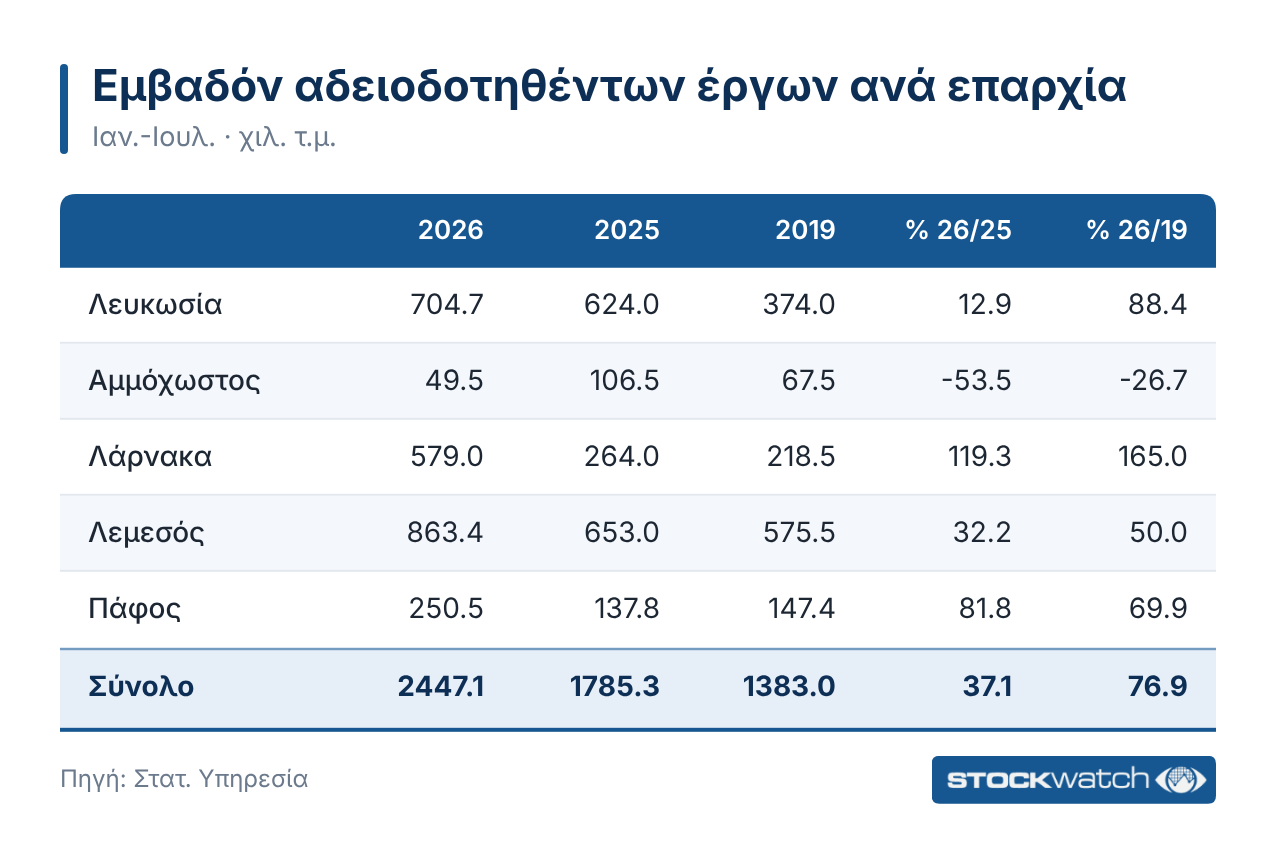
Larnaca showed the highest percentage growth. From January through July 2026, the total area of approved projects in the district reached 579,000 m² compared to 264,000 m² during the same period in 2025. This represents a 119.3% increase.
Paphos ranked second. There, the area increased by 81.8%, from 137,800 m² to 250,500 m².
Limassol retained first place in terms of the total area of approved projects. Over seven months, it totaled 863,400 square meters, compared to 653,000 square meters a year earlier. This represents a 32.2% increase.
In Nicosia, the figure reached 704,700 m² compared to 624,000 m², an increase of 12.9%.
The only district to record a decline was the free areas of Famagusta. The area of projects decreased by 53.5%—from 106,500 m² to 49,500 m².
Compared to 2019, the total area of approved construction projects in Cyprus increased by 76.9%—from 1.383 million m² to 2,447,100 m².
By city, the trends are as follows:
Larnaca — a 165% increase
Nicosia — an 88.4% increase
Paphos — 69.9% increase
Limassol — 50% increase
Unoccupied areas of Famagusta — a 26.7% decrease
Project Value
The total value of projects that received building permits from January through July 2026 reached 2.987 billion euros. During the same period in 2025, it amounted to 2.189 billion euros. Thus, the increase was 36.5%.
The value of residential construction projects increased by 56.9%—from 1.634 billion to 2.563 billion euros. In civil engineering, the figure rose by 22.5%—from 81.4 million to 99.6 million euros.
Particularly notable growth was observed in land subdivision projects: their value increased by 136%—from 16.6 million to 39.2 million euros. The value of road construction projects rose by 134.3 percent—from 3.9 million to 9 million euros. At the same time, the value of non-residential buildings fell by 39.1 percent—from 453.4 million to 276.1 million euros.
In July, the total value of approved projects amounted to 418.0 million euros. This figure included:
350.3 million euros for residential buildings;
€49.8 million for non-residential buildings;
6.8 million euros — engineering projects;
10.4 million euros for land subdivision;
714,000 euros — road construction.
Number of Permits
From January through July 2026, 5,173 permits were issued in Cyprus, compared to 4,195 during the same period in 2025. This represents a 23.3% increase.
By project category, the figures are as follows:
Residential buildings — 3,786 permits compared to 3,169, an increase of 19.5%
Non-residential buildings — 469 compared to 446, an increase of 5.2%
Engineering projects — 294 compared to 231, an increase of 27.3%
Land subdivision — 515 compared to 293, an increase of 75.8%
Road construction — 109 compared to 56, an increase of 94.6%
In July, 772 permits were issued, which is 3.0% fewer than in the same month of 2025. Of these, 559 were for residential buildings, 63 for non-residential buildings, 44 for engineering projects, 92 for land subdivision, and 14 for road construction.
Another important indicator is the number of new residential units whose construction is authorized by the permits issued. In the first seven months of 2026, 13,044 houses and apartments are planned to be built. A year earlier, this figure stood at 8,128. The increase reached 60.5%.
Apartments in multi-unit residential buildings account for the largest share: 9,298 units are planned, compared to 5,285 a year earlier. This represents a 75.9% increase.
In the other categories, the trends are as follows:
Single-family homes—2,039 compared to 2,018, a 1% increase.
Duplexes—805 compared to 645, a 24.8% increase.
Residential and commercial multi-unit buildings—902 units compared to 180, a 401.1% increase.
In July alone, permits were issued for the construction of 1,944 residential units. Of these, 279 were single-family homes, 134 were two-family homes, 1,466 were apartments in residential multi-unit buildings, and 65 were residential units in mixed-use residential and commercial buildings.
Thus, it is multi-unit projects that account for the bulk of the growth in housing construction in Cyprus. The number of private homes approved over the year remained virtually unchanged.