

Just over a decade ago sharing a house in Cyprus wasn't common. But with the ever increasing number of expats and digital nomads and the rising rental prices, it has become a popular option not only with students but also amongst professionals. When done right, sharing a house or an apartment can be a rewarding experience — you might expand your social circle and save on rent and utility bills along the way. Today, we’ll shed some light on the island's shared accommodation market and walk you through the rental process and some of the most common pitfalls to avoid.
Types of Shared Housing in Cyprus
Currently there are several options when it comes to shared accommodation in Cyprus: from renting a room to co-living spaces. Let's see how they differ.
Rooms in Shared Apartments
It's the classic Cyprus flatshare: you get your own bedroom and share the kitchen, bathroom and living room with whoever else lives there. It's about the cheapest way to rent, because you only pay for your room and split the bills.
What you end up with depends on your budget and the area. It could be a big, bright bedroom in a new build, or a box room in a tired old flat. Sometimes the landlord lets each room separately. Other times one tenant takes the whole place and finds flatmates to cover the rest.
Co-Living Spaces
Co-living is still fairly new to Cyprus, but it's taking off with digital nomads and remote workers who want a place that actually feels like home.
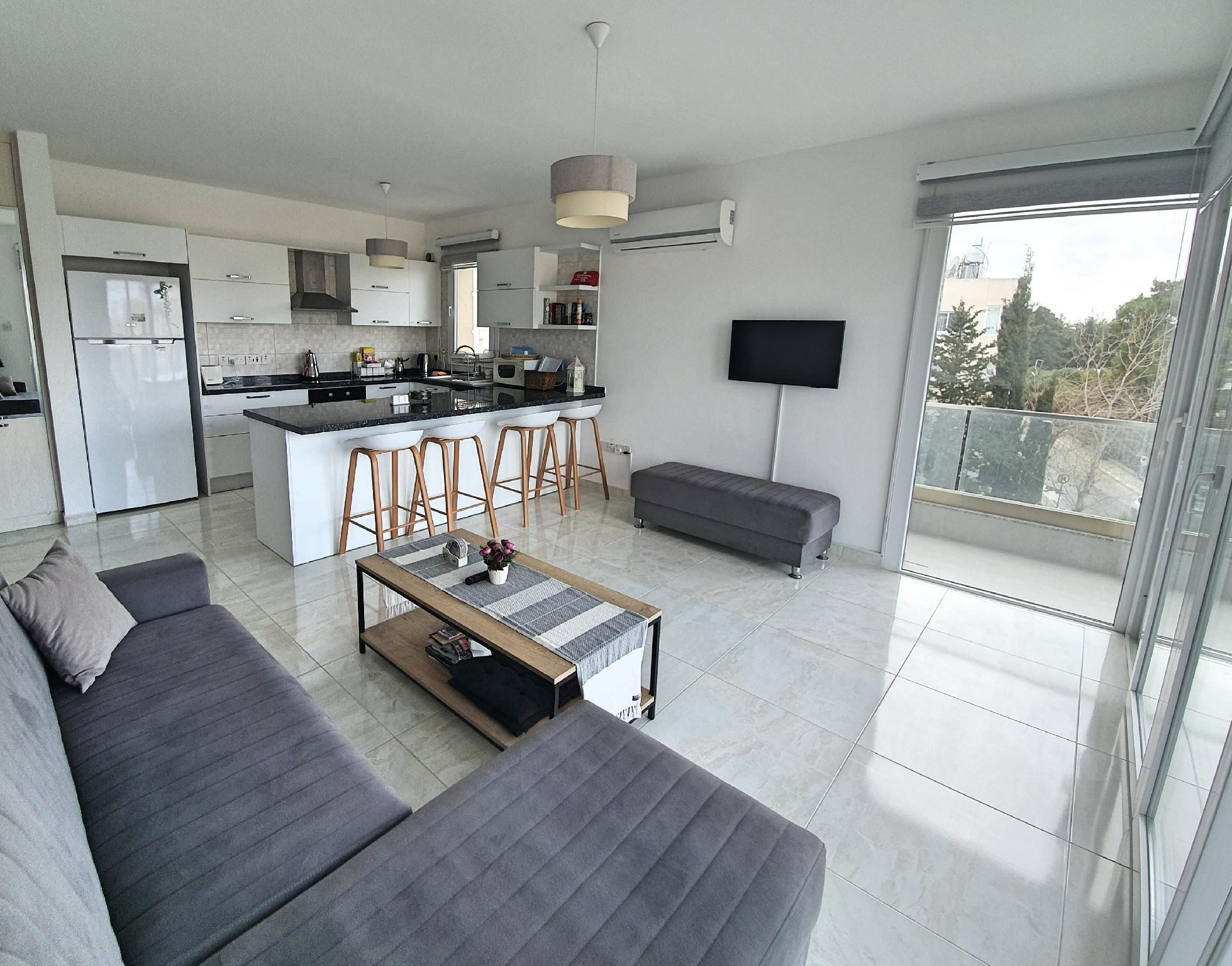
You'll have your own furnished room and share the rest with your housemates. Usually that means a proper kitchen, a table big enough for group dinners, and a living room with sofas and a TV. A lot of places set aside a corner for working, with decent Wi-Fi. Outside, many Cyprus co-living places have a terrace or a garden with a BBQ, and the nicer ones have a pool or a rooftop that's perfect for sunset drinks.
Laundry, bike storage and parking are usually covered, and some places add a small gym, a yoga corner or a games room. What you pay each month varies, but most co-living spots in Cyprus include wifi, the bills, cleaning of the shared areas and the odd social night.
Short-Term and Flexible Flatshares
This option usually means you can rent a room in a shared flat for a short stretch, anywhere from a few weeks to a few months. A normal lease ties you in for a year or more, but these arrangements are built for people whose plans might change. It's also much easier to move in, with less paperwork and less stuff to sort out.
Most rooms come furnished, and the rent often covers electricity, water and Wi-Fi. Some places even throw in cleaning.
One thing to know: people move in and out all the time, especially in touristy areas or in flats aimed at visitors. Don't get too attached to your flatmates.
But if you've just got to Cyprus, it works well. You can try out a few towns, get used to a new job, and take your time finding a proper place.

Where to Find a Room in Cyprus
Finding a Cyprus flatshare isn't difficult when you know where to look.
One of the most popular ways to find rooms for rent is searching for listings on popular online platforms, such as Bazaraki and Facebook Marketplace. Typically they allow you to compare locations, prices, property conditions and rental terms in one click. Some property agency websites can also be helpful, but not all of them specialise in rooms for rent.
Facebook groups and expat community channels are another effective way of finding that perfect flatmate or roomshare.
Expat and international resident groups are usually full of flatmate-wanted posts and rooms for rent listings. Many even describe the atmosphere at home, which makes it easier to find a flatmate you'll actually click with. Also members can share their experiences about neighbourhoods, transport, landlords and the practicalities of living together. It can be a great place to meet potential housemates before deciding to share a property. Personal connections and recommendations are another good way to find a place. In Cyprus room rentals are often advertised through a friend, colleague or acquaintance. So don't be shy to ask around — there's a good chance someone will know of a room for rent.
Choosing the Right Area
The best tip for finding a good area is to look for expat-friendly suburbs — they provide the perfect balance between affordable pricing and accessibility.
Limassol and Nicosia
Limassol is easily the priciest city in Cyprus, and homes near the seafront and the main business districts come at a premium. For somewhere practical and central, look at Mesa Geitonia and Agia Zoni, which have apartment blocks, shops and quick access to the middle of town.
Agios Athanasios is popular with expats too, and if you're after something cheaper, Zakaki is worth a look.
Nicosia is rapidly gaining popularity with expats. The capital has long established itself as a prime university destination, and recently it started attracting foreign working professionals.
The best areas to find a place in Nicosia are expat-friendly suburbs. For example, Strovolos — a large residential area with quality amenities and a variety of apartment buildings. Or, Aglantzia which combines urban comforts with lush green spaces. Engomi is a rather upmarket residential area with higher prices, but a comfortable lifestyle. And for something more affordable, but still central, check out Kaimakli.
Larnaca and Paphos
Compared to Nicosia and Limassol, Larnaca is a more compact city. One of the easiest areas to find a place is the city centre that offers a mix of new and renovated apartments. For something more exclusive, try Mackenzie — a coastal area with some newer apartments as well as restaurants, cafés and beach bars.
Kamares — is a more residential part of Larnaca, with easy access to everyday amenities and the city centre. Slightly further away from the city are Oroklini and Aradippou, which offer more spacious living at affordable prices.
Paphos has always been loved by expats and recently it's becoming more cosmopolitan, thanks to the influx of foreign professionals and digital nomads. The best area for finding flatshare is Universal — it's very central and has many apartment complexes. Geroskipou and Chloraka are also very popular with expats and offer a mix of houses and apartments for rent.

How Room Prices Are Calculated
There's more to room rental prices that meets the eye. Ultimately you're paying not just for a room, but also for the location, condition and all the extras.
Location, Room Size and Property Condition
Generally, in Cyprus central and coastal areas tend to be more pricey. The same goes for established and upmarket residential neighbourhoods with easy access to amenities. Whereas some outer residential areas tend to be cheaper, but getting around could require more effort.
The room size is also very important — a larger bedroom with an ensuite would cost much more than a basic moderate-size room. Also, you could pay more if there's a balcony or an attractive view, built-in wardrobes and additional storage.
But the size of the room isn't everything — the condition is what really matters. Sometimes a smaller bedroom in a recently renovated apartment with modern fittings can command a premium over a larger bedroom in an older apartment.
Furnished Versus Unfurnished Rooms
Typically you can find ads for both furnished and unfurnished flatshare. Choosing between the two all depends on how long you’re planning to stay. If you intend to stay less than 6 months, purchasing furniture might not be worth it, unless you manage to find it for free. So for short-term rentals it might be easier to find a furnished option. But if you're planning on staying long-term, renting an unfurnished room and buying your own furniture could work out cheaper in the long run.
Seasonal Demand and Short-Term Premiums
Cyprus has a seasonal rental market, especially in touristy areas. In the high season, demand can rise and some landlords can really up the prices and offer only short stays.
But, starting from November as the demand from tourists drops, owners might start looking for longer-term tenants and offer better prices. This is usually true for Paphos, Larnaca and Ayia Napa, whereas rentals in Limassol and Nicosia remain roughly the same.
Splitting Rent and Household Bills
When there's a shared meter for the whole household, splitting and paying the bills without a formal agreement can be a challenge.
Electricity can be one of the most unpredictable costs that can quickly ramp up the overall expenses. It is usually split equally between everyone in the flat, or however you all agree. If one person uses way more, you can work out a different split, or fit sub-meters if the setup allows it.
Water costs a lot less, so with a single meter for the whole flat, most people just divide it evenly.
Internet is probably the easiest bill to split because a household broadband subscription has a fixed monthly price. But before agreeing to share a connection, check whether the service is reliable. Also establish who is responsible for the account and what happens if the contract must be cancelled when someone moves out.
Communal building charges can also add up to the bills, especially if you're renting an apartment.
Depending on the building, they can cover:
- Cleaning stairwells, corridors and entrances.
- Electricity for communal lighting and lifts.
- Lift servicing and maintenance.
- Gardening and shared outdoor spaces.
- Swimming pool maintenance.
- Management and other shared building expenses.
The costs depend on the facilities and management arrangements of the building.
In Cyprus the owner usually pays for these themselves.
Before you move in, ask whether these expenses are on top of the rent or already included.
Get the deposit terms written down, and ask for a receipt when you hand the money over. Then photograph the room on day one and record any defects, like the scuffed walls, the stained carpet, the wobbly wardrobe door. It's the only way to win the argument when you leave.
And the small stuff adds up too: bin bags, washing-up liquid, a light bulb or toilet paper. Some flatmates all chip in, while others just take turns buying. So it's good to discuss how it's arranged beforehand.

Contracts and Legal Arrangements in Cyprus
When it comes to Cyprus room rental, the most important question is not simply how much you pay. It is whose name is on the rental agreement, and what happens if the arrangement changes.
Individual Versus Joint Tenancy Agreements
An individual agreement means that you sign a rental contract for your own bedroom. One of its biggest advantages is that you have your own contract with the landlord, which eliminates potential misunderstandings. Before signing it make sure to check that the agreement specifies which room is yours and what happens if other residents leave.
A joint agreement means that several residents sign one contract with the landlord for the whole apartment. With this arrangement, everyone is formally named in the agreement and you can agree in advance how to handle replacement tenants and deposits.
One downside is that the landlord may be able to pursue any one of the tenants for the full outstanding rent, rather than only that person's share. This depends on the wording of the contract so make sure to read it carefully.
Subletting and Landlord Permission
Subletting happens when a tenant rents all or part of a property to another person. It usually means that the existing tenant remains responsible for the main lease, while you sign a separate room-rental agreement with them. Before signing this agreement, you should first establish that the tenant is authorised to rent the room to you.
Most Cyprus rental agreements don't let you sublet without the owner's permission. If you do it anyway, you could be in breach of your contract, and in some cases that can end in eviction. So get the owner's okay in writing before you take anyone in.
What Happens if One Flatmate Moves Out
This is one of the most important issues to clarify before signing a shared rental agreement. The consequences depend on whether the departing person has an individual contract or a joint lease.
If an individual agreement is in place, then the departing tenant must follow their own contract's notice and termination provisions.
In case of a joint agreement though, the other residents may still be responsible for the full rent under the joint agreement, depending on its terms.
If you sublet a room from another tenant, the situation is even more complex as your agreement is with that person rather than with the owner. So if the lead tenant decides to leave, it doesn't automatically mean that you can remain in the apartment or take over the original lease. That's why if you sign a joint or a sublet agreement read the contract terms carefully.

Deposits and Payments
When renting a room in Cyprus, you need to understand three things: who holds your deposit, who receives your rent, and how you get your deposit back when you leave.
In Cyprus you can find three most common types of arrangements:
- You pay a deposit directly to the landlord (usually when you sign an individual rental agreement).
- The lead tenant holds your deposit if you have signed a subletting agreement with that person.
- An agency or property manager collects the deposit on the owner's behalf if you're renting through a real estate agency.
Cyprus has nothing like the UK's tenancy-deposit protection scheme. So before you transfer anything, check who you're actually paying, and agree in writing when and how you'll get the deposit back.
Pay in the way your written agreement says and put the month and the room or address in the reference. Then keep the confirmation. If there's ever a dispute, that screenshot is your proof.
Important notice: As of 1 July 2026, Cyprus has introduced a requirement for rental payments to be made electronically under the applicable legislation. The government identifies bank transfers, debit or credit card payments and other recognised electronic methods. Cash rent payments are prohibited under the new rule.
Your deposit should also be dealt with according to your rental agreement. In order to get it back, you must comply with the contract's notice and termination requirements.
Landlords can take money off your deposit for things like unpaid rent or bills, missing items, and damage that goes beyond normal wear and tear. What they can actually deduct usually comes down to your contract and the local law.
If your landlord won't give the deposit back, put your request in writing. Include the amount, your move-out date and your payment details, and ask for an itemised list of any deductions. If it still isn't sorted, a Cyprus-qualified lawyer can tell you which legal route makes sense.

House Rules and Everyday Living
Sharing a place comes with responsibilities. Each shared household sets out its own rules when it comes to cleaning, cooking and sharing common areas.
For example, each household has its own approach to cleaning. Some like to share the cleaning duties and everyone takes turns with weekly tasks. Others can be more laidback and might not have a fixed cleaning schedule. While busy professionals might opt to hire a paid cleaner, who comes once or twice a week, and just split the costs. Before making a commitment it's important to meet the tenants and discuss shared responsibilities.
Some shared homes welcome visitors freely, others have stricter rules, so it pays to ask some questions before moving in. Check if residents should give advance notice, when inviting someone. Ask if overnight guests are allowed or not.
Ask about parties and gatherings too. Also, find out what the quiet hours are — they may differ per household.
And if you do work from home, aim for a bigger private bedroom with a desk in a calm house. A slightly cheaper room in a noisy one will cost you more in the end. Food is another thing to consider. Some houses cook together, some keep everything separate, and plenty sit in the middle and share basics like oil and coffee. If you'll be buying your own, say so and ask for a shelf in the fridge and a corner in a cupboard. Last, get the house habits out in the open: smoking, laundry, pets, and who gets to switch the AC on.
Red Flags When Renting a Room
When you're searching for shared accommodation online, it helps to know the common red flags.
No written agreement
Sometimes a landlord or lead tenant will offer to sort everything out verbally. But what happens if you're asked to leave with no notice, or hit with charges you weren't expecting? That's exactly when you'll be glad to have it in writing.
A proper contract must outline:
- The exact monthly rent and deposit.
- Whether bills are included in the rent.
- How much notice you must give before leaving.
- Whether the landlord can ask you to leave and under what circumstances.
- When your deposit should be returned and what deductions are permitted.
- Whether you are renting directly from the landlord or subletting from another tenant.
Unclear Bills and Extra Charges
One of the most frustrating situations is finding a room advertised for an attractive monthly price, only to discover that your actual housing costs are much higher. Sharing utility bills can be tricky, if the exact arrangement has not been agreed on in advance. Be especially careful if someone says that everything is included, instead clarify exactly which utilities are covered. A reasonable arrangement should explain the calculation clearly and allow you to check the charges.
Requests for Payment Before Viewing
This is one of the most serious warning signs when looking for a Cyprus flatshare.
Fraudsters sometimes copy photographs from genuine listings and advertise the property at an attractive price, hoping to collect deposits from people who cannot visit in person.
So if someone says things like: «there are several people interested, so you must pay today», or «pay a reservation fee first, and then you can arrange a viewing», don't rush to make a payment. Be especially careful if they direct you to a special booking website to make your payment.
To protect yourself from potential scammers, view the actual room in person. Or, if you’re abroad, the safest option is to have a trusted person inspect it on your behalf. Also, verify who you are dealing with and establish whether the person is the owner, an authorised agent or a lead tenant.

What to Check Before Moving In
When you go to view the place, just look around properly. Is your room clean? What about the kitchen and bathroom? Check the corners and ceilings for mould, especially if you're near the sea.
If the room is furnished, check out the bed, mattress, chair and table.
Turn the AC on and see if it actually works, and ask how they heat the place in winter. Open and close every window and door, and try the lock on your own door too.
Think about the summer as well. Can you get a proper breeze through the room, or does the sun bake it all afternoon?
Then ask who lives there. How many people are in the flat right now, and how many of them share a bathroom with you. Ask if anyone else is about to move in. You'd want to know that before you sign anything.
If the property isn't brand new, it's a good idea to record any existing damage.
Take photos and close-ups of any existing dents, scratchmarks, cracks, stains or breakages and create an inventory of any defects. Then share these files with the landlord or lead tenant, so there is a record of the property's condition at the beginning of your tenancy. It's a good idea to ask them to acknowledge these damages in writing before you move in.
Leaving a Flatshare
There comes a time when you need to leave — either the agreement is coming to an end, or your plans have changed and you need to move out early. Let's see how to navigate both scenarios.
Notice Periods
In Cyprus the length of a notice period depends on the rental agreement that you have. Notice periods can be a month or longer, depending on what you and your landlord agreed. Whatever it is, give notice in writing, ideally by email. Say clearly when you plan to move out and ask them to confirm that date back to you in writing. Keep copies of everything. But if you're on a fixed-term contract and want out early, a month's notice won't automatically free you from the rest of the term. You could still owe rent until it ends.
Replacing Yourself With a New Tenant
If you have to leave before your agreement runs out, finding someone to take over your room can help. Whether that's allowed depends on your contract, though, and the landlord gets the final say.
So start by talking to the landlord or lead tenant and see if they're okay with a replacement. Once they are, sort out who does what: who puts the ad up, who shows people round, and who gets to approve whoever applies. Also confirm when your own responsibility for rent ends and what happens to your deposit. Finally, document the handover — ideally, the new tenant signs a new agreement or a formal agreement transferring the tenancy.
Final Bills, Keys and Deposit Settlement
Before you leave, get the bills sorted. Ask for copies of any bills still unpaid. Then split the bill as you always do, just double-check the dates it covers. And pay in a way that leaves a trail. Bank transfer is best, and screenshot the confirmation. If there's ever an argument later, that screenshot ends it.
Hand back every key from that property and ask for written confirmation of the date you returned them and surrendered possession of the room. Once you've moved out, it's time to get your deposit back. Your landlord or lead tenant owes you a proper breakdown of what's happening with the deposit. That means every deduction they want to make, whether it's rent you haven't paid, bills still open, or damage they say you caused. Get a refund date from them in writing, even if it's just a text.
If they argue or try to take money you don't think they should, get your paperwork out: your contract, payment records, any photos you took and the messages between you. Having it all in one place makes a dispute much easier to win.

Sharing accommodation in Cyprus is a great way to settle in, make new connections and keep your living costs down. But when you're ready for more privacy and independence, it might be time to find a place of your own. Explore our catalogue of rental properties for any taste and budget: from affordable flats to upscale inner-city apartments.
Read also:
- Curium Palace in Limassol: The Story of an Iconic Hotel Demolished for a New Project
- Taxis in Cyprus: Apps, Prices and How to Book
- Buying Used Furniture in Cyprus: Marketplace Tips, Delivery and Red Flags
- Curium Palace in Limassol: The Story of an Iconic Hotel Demolished for a New Project
- UV Index and Wind in Cyprus: How to Read the Weather Forecast