Utilities in Cyprus differ significantly in cost from those in Russia. In 2026, they are breaking records across Europe: the average monthly bill is €150–€400. In Russia, for reference, the range is €40–€80 when converted to euros. Utility expenses depend heavily on a number of factors: season, tariffs, type and condition of housing, etc. They are supplemented by mandatory charges: tax, insurance, and municipal fees.
Cost of utilities in Cyprus
Electricity and water supply are the main cost categories. These are the items that can vary greatly in price, and the payer can reduce expenses on these bills.
What the total cost of utilities depends on:
- living area size and number of floors;
- the material the house is built from;
- presence of panoramic windows, balconies, loggias, and their glazing;
- quality and number of windows;
- room orientation by cardinal directions;
- quality of renovation (no gaps, working plumbing);
- electricity/water consumption class of household appliances;
- small savings measures — LED fixtures, faucet aerators;
- heating method and system: gas, electricity, fuel oil;
- water heating method;
- resource-saving technologies: rainwater collection, use of solar energy;
- tariffs (can vary greatly; more on this below);
- number of residents and their habits.
If an apartment or house is well designed, built, and equipped from the start, you can significantly reduce utility costs.
Note! Some utility bills in Cyprus must be paid once every two months.
How much utilities cost in Cyprus: an averaged comparison table:
Living area | Electricity | Water supply | Heating / air conditioning (electric or gas) | Internet/TV | Total per month |
Apartments 60–80 m2 | €30–€60 | €20–€30 | €50–€150 | €40 | €140–€280 |
House 150 m2 | €50–€70 | €30–€50 | €60–€180 | €50 | €190–€350 |
Villa 300 m2 with a pool | €80–€150 | €40–€90 | €80–€200 | €60 | €260–€500 |
Prices are given as an average range for seasons when heating or air conditioning must be used activly. In the shoulder season, payments can be noticeably lower.
What utility payments consist of
Electricity: features and tariffs
Electricity in Cyprus — is among the most expensive not only in the EU, but in the whole world (as of early 2026). This is due to the lack of natural fuel on the island. Fuel oil for boiler houses is brought from the mainland — which means locals pay not only for the fuel, but also for its transportation.
Note! In recent years, Cyprus has been actively building solar panel parks. This will significantly improve the situation once they all become fully operational.
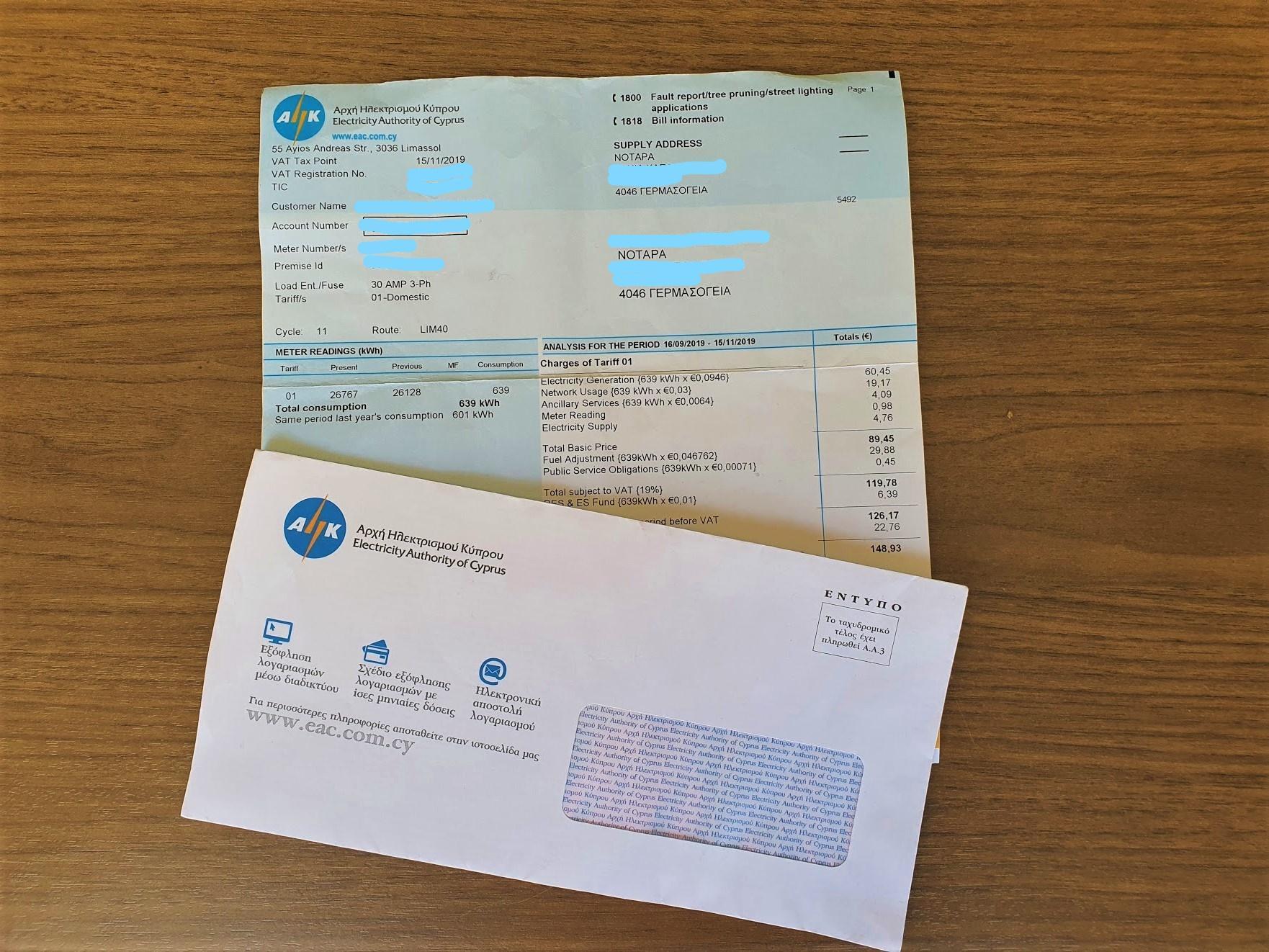
The tariff system for (household) home electricity use is not the simplest at first glance. The cost per kilowatt depends on which grid the consumer is connected to (high-, medium-, or low-voltage), which transmission system is used, and whether discounted periods apply (certain days and hours).
The electricity-only price range is: from 8.48 euro cents/kWh to 12.80 euro cents/kWh.
*according to EAC data as of early 2026
Important! In Cyprus, the bill is made up not only of the number of kilowatts consumed multiplied by their price. Other charges are included as well: connection, service, and supply. Therefore, the OVERALL cost per kilowatt will be two, or even three times higher.
Example 1: EAC standard tariff
One kilowatt costs 10.34 euro cents.
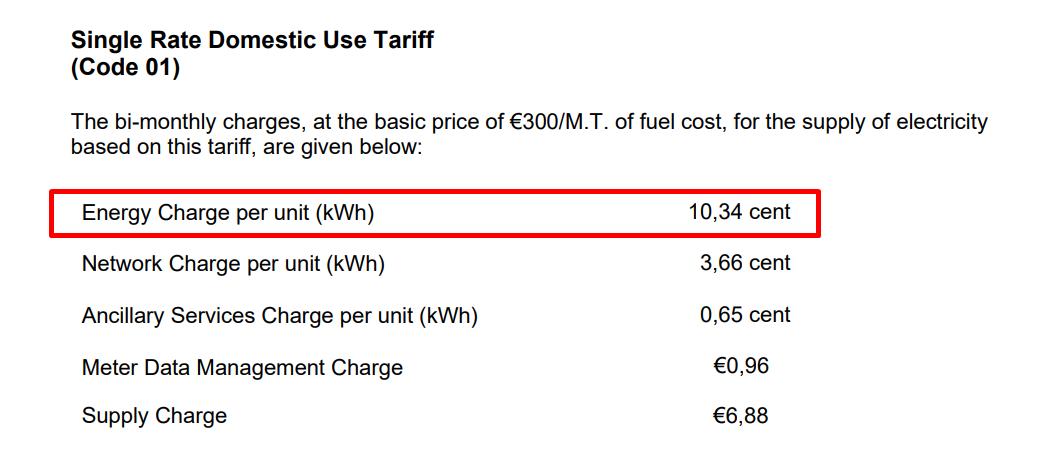
The final cost per kilowatt = 22.49 euro cents.
However, if you ask Cypriots, they will say they pay 10.34 per kilowatt, because they will count only the main line item. Russians, by habit, count everything at once, so for them the cost per kilowatt will look like 22.49. Sometimes this creates confusion.
Example 2: Tariff with discounted periods (at night)
One kilowatt costs 10.76 euro cents during daytime hours and 9.44 euro cents during nighttime hours. The other charges remain unchanged.
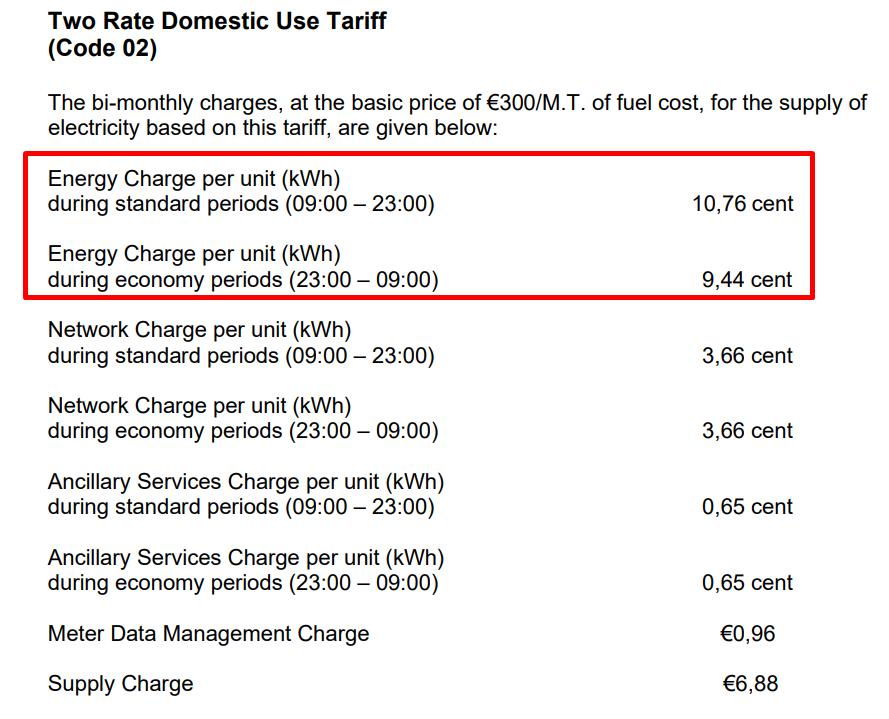
Total: during the day a kilowatt will cost 22.91 euro cents, at night —21.59 euro cents.
Many residents choose a tariff that reduces the price during nighttime hours, holidays, and weekends. This is especially convenient for those who use heat-accumulating appliances, for example water boilers. At night the family heats the water, and during the day turns off heating. That’s also when you can run the washing machine and dishwasher and switch on heaters to warm the home.
You can check the exact electricity tariff rates in Cyprus on the official EAC website.
Water supply and sewerage
Cyprus also has problems with water supply: there are no natural sources of fresh water. The coast uses desalinated seawater, while foothill and mountain areas literally store rainwater in artificial dams.
Important! Desalinated water must not be drunk — even after filtering and boiling!
Owners of private houses can drill a well. But it’s not that simple: in many places the Cyprus government prohibits such works. Sometimes a license is required. And in general, drilling on the island is a very expensive undertaking.
Water costs depend primarily on monthly consumption volume. The less precious water a person uses, the lower the tariff the state will provide. The payment consists of a fixed part and the price per cubic meter:
- consumption up to 40 m3 — at €0.9;
- consumption up to 80 m3 — at €1.4;
- consumption up to 120 m3 — at €2.3;
- consumption above 120 m3 per month — at €5.
You also have to pay for wastewater disposal, i.e., sewerage. On average, the price is €0.6 per cubic meter.
Heating and air conditioning
Cyprus has no centralized heating. But in winter you cannot avoid heating your home: the temperature outside drops to 5–8°C, and the walls have time to get cold.
Each resident heats their apartment or house as best they can: with electricity, gas, or fuel oil. In high-mountain villages, houses may be equipped with a fireplace. Which heating scenarios are relevant in Cyprus:
- Older apartment stock: usually only an air conditioner or electric heater. It’s easy to imagine this is very expensive, so Cypriots save however they can — they heat only one room before sleep, walk around the home in truly warm footwear, and use electric blankets.
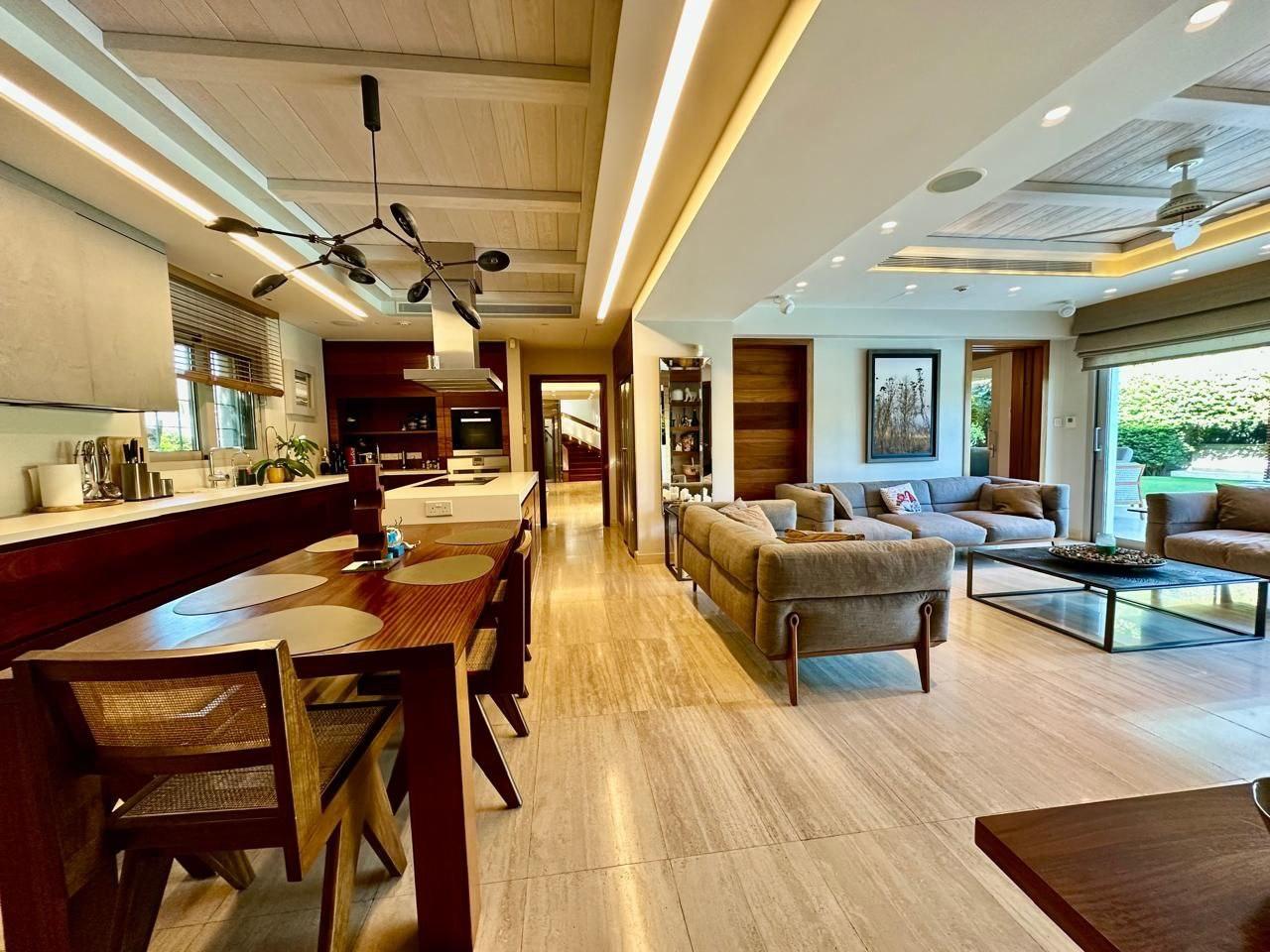
- Newer apartment stock: underfloor heating (electric or electric-hydronic), VRV air-conditioning system. In new buildings with solar panels, a kilowatt may cost significantly less, and this is strongly felt in winter. In modern luxury apartments, radiators are sometimes installed, but overall this is still rare for Cyprus.
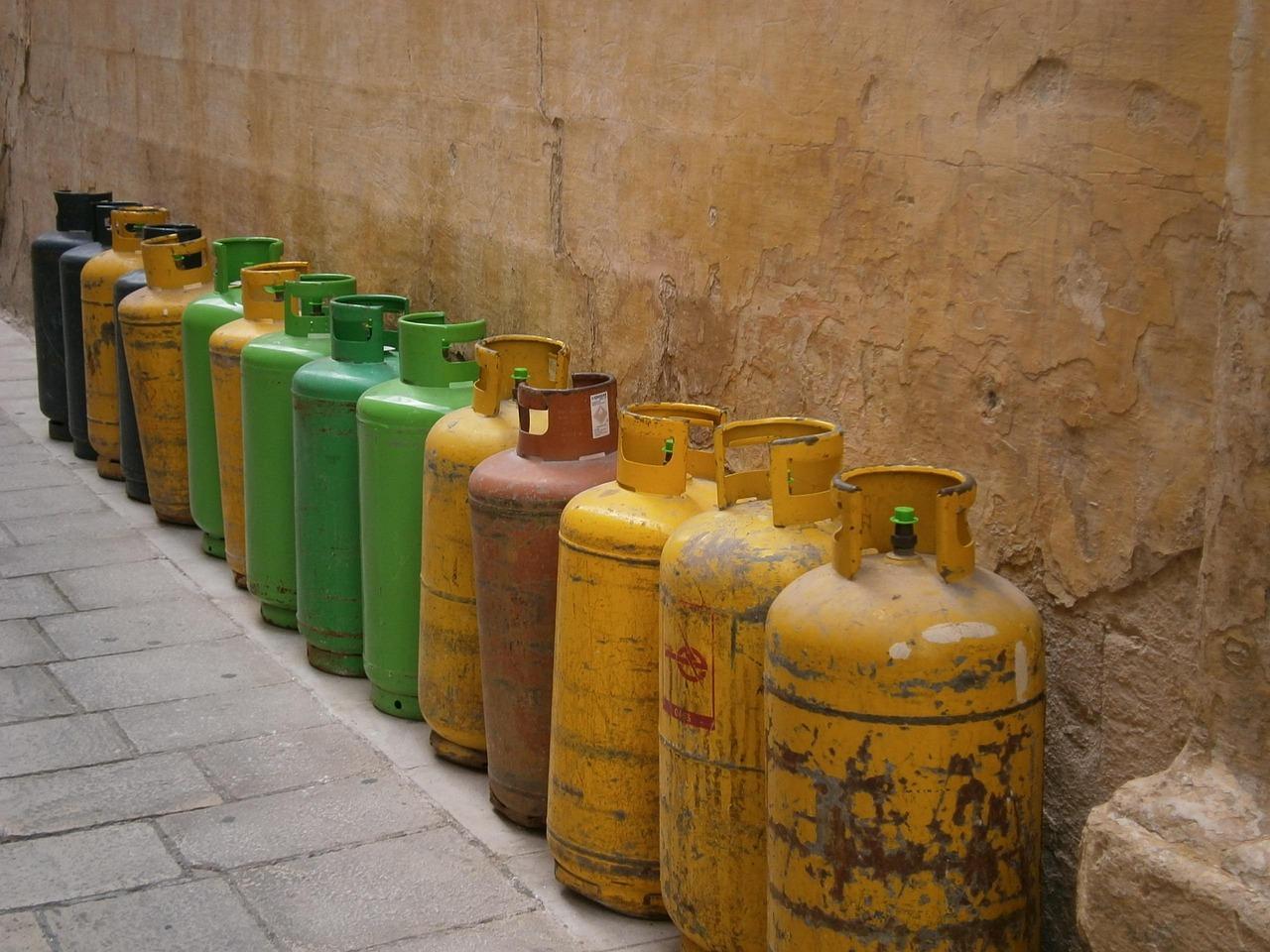
- Private house with a boiler room: may have hydronic heating on gas or fuel oil. Gas is sold in cylinders, and 2–3 cylinders per month may be used for a medium-sized cottage.
- Private house without a boiler room: electric heating in all forms — underfloor heating, radiators, less often heat-recovery systems. Modern homes are increasingly equipped with photovoltaic panels, and this is ideal for Cyprus: the sun shines about 300 days a year.
Tip! If a home has gas, you can use it to heat water as well.
Gas and other fuel
One gas cylinder costs €10–15. In a summer month, a family of three may not use even one cylinder — but in winter you’ll have to buy 2–3 at once. Still, it’s cheaper than heating the home with electricity.
In private houses, gas is not always used: fuel oil works too. It’s not the most eco-friendly option, so it is gradually fading into the background.
Internet, TV, and mobile service
A combined home package of internet with TV and landline costs €40–60 per month. This amount does not include mobile internet: it costs around €20–30.
Garbage collection and municipal fees
These utilities in Cyprus are mandatory: every resident pays for waste disposal, street lighting maintenance, and the road network. The amount is quite small: €100–300 per year. In upscale areas, waste collection, for example, costs more.
Other mandatory housing expenses
Complex maintenance
In an apartment building or a complex of private villas, you must pay for management company services: keeping entrances and surrounding areas clean, security, parking, operation of gyms, pools, concierges, and more. The more upscale the complex, the higher the payments. On average, annual maintenance for an economy-class complex is €350–500, for luxury-class — about €1500
Property taxes
The property ownership tax in Cyprus has been abolished. However, owners still have an obligation to pay a municipal tax. Its rate is set by the municipality (usually 0.1–0.2%) and is tied to the value of the property.
That means owners of an apartment worth €150,000 will pay €150 per year. And owners of a villa worth €700,000 — €700.
Do not forget that when renting out housing, the owner receives income and therefore must pay tax on it. The same applies to the owner if they sell their property.
Home insurance
Buying insurance is not mandatory, but in Cyprus it is customary to protect yourself from possible troubles and risks. Especially since the annual amount is not very large. Usually it is calculated from the property value — about 0.1%.
As a guideline, insuring an apartment worth €200,000 costs €200–250, and a villa worth €800,000 with an extended package — about €1500.
How to save: 12 proven tips
At the very beginning of the article, it was said that the size of utility bills can be reduced — in some cases quite noticeably. No tricks — just a rational approach and conscious consumption!
Building or buying property with an energy efficiency class A or higher. Energy efficiency means low consumption of external resources. Such housing costs about 10% more, but pays off in 5–7 years — i.e., noticeable savings will come quite soon. Class A+ and A++ homes can cut external electricity consumption by 50–90%!
- Use solar panels on the roof of a private house.
- Use rainwater collection systems. Cyprus has an arid climate, but in the cold season precipitation is still not rare.
- When building a private house, place large windows, loggias, and doors on the south side.
- Monitor the condition of the home: no gaps, double-glazed windows, and quality insulation help reduce heat loss.
- Buy appliances and lamps with low electricity consumption.
- In private houses, use tanks for storing and heating water. The tank is placed on the roof, and during the day the sun heats the water to 50–60°C.
- Run appliances as much as possible in the evening, during the “cheap hours” under the night tariff: from 23:00 to 09:00. This can include the washing machine, dryer, and dishwasher, a water boiler, air conditioners, and heaters.
- Check plumbing for leaks. Drip by drip, a noticeable amount can add up over a month.
- Buy aerators — faucet attachments — and install touchless plumbing. Over a year, you can save about 25% on average with these alone!
- Remember reasonable consumption: don’t turn on lights in an empty room; don’t heat a room that won’t be used soon; don’t let water run while washing fruit and vegetables or brushing teeth. If desired, you can set up a mini greywater reuse system at home (for example, water from the sink flows into the toilet tank).
- Try to choose suitable tariffs.
- In private houses, it’s best to use gas for heating rooms and heating water. Fuel oil is inexpensive but less eco-friendly; electricity is economical only if the cottage is equipped with photovoltaic panels.
Tip! In Cyprus, landlords often keep some utilities in their own name. This is convenient, but costs money. If you move often, try to agree with owners to pay utility bills under their name.
Indeed, utilities in Cyprus cannot be called cheap. The total bill for two months can reach €500 for a family of three living in an apartment. Maintaining private houses, especially in winter with heating and in summer with air conditioning, costs even more. But technology does not stand still: with its help, you can significantly reduce consumption of expensive resources.
Read also:
- Best areas of Cyprus for high-yield rentals. Best places for high ROI
- Wedding traditions of Cyprus — rituals, symbols, and features of local celebrations
- Traditional Cypriot jewelry: history, Lefkara silver, and filigree technique
- Top 10 new developments in Limassol to be delivered in 2026
- Kindergartens in Cyprus: how they work, how much they cost, and what parents should know