

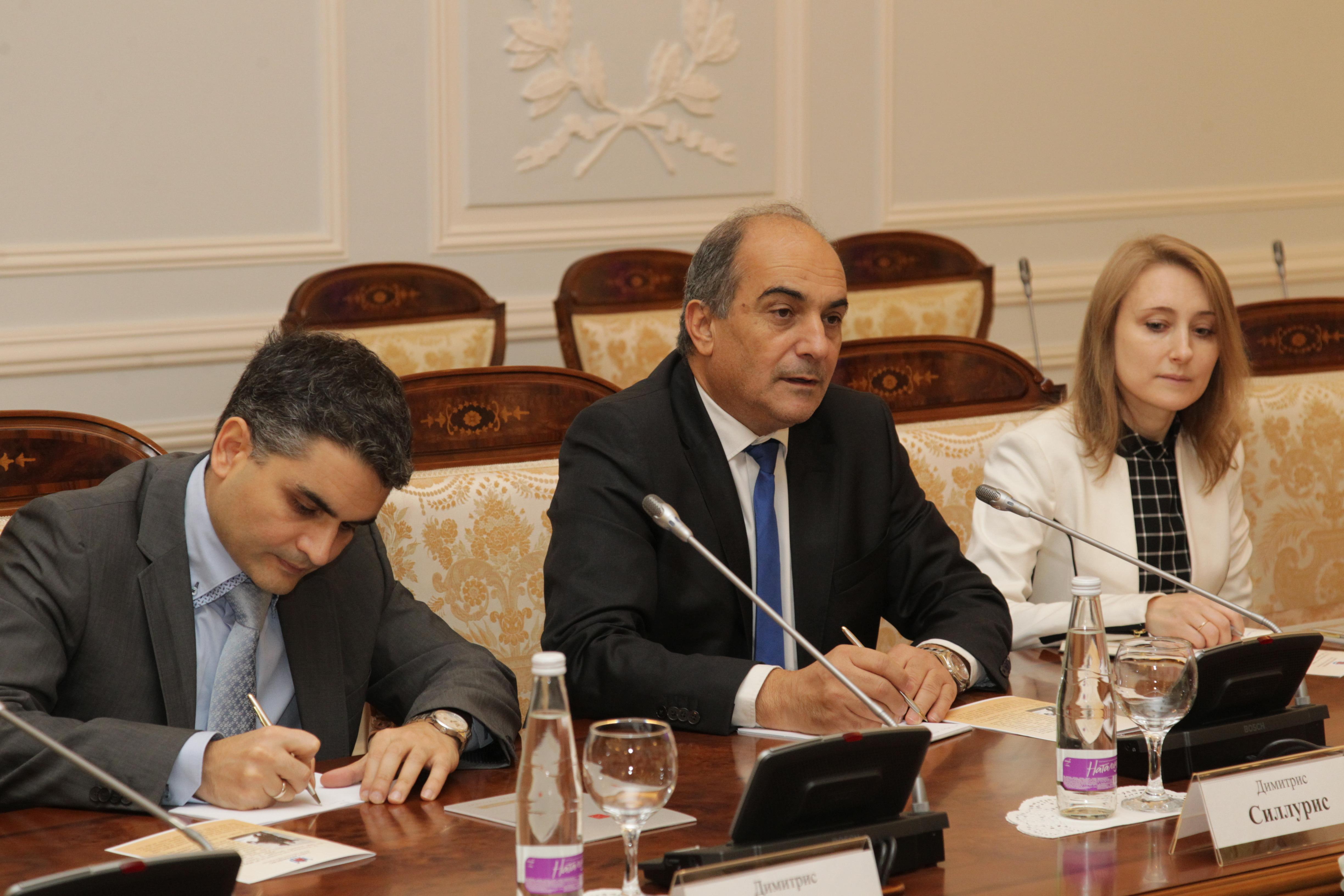
On Monday, December 15, the final phase of a high-profile criminal trial began at the Nicosia Criminal Court, linked to the investigation into the illegal granting of so-called “golden” passports. The defendants are former Speaker of the Cypriot Parliament Dimitris Syllouris and former MP Christakis Giovani. During closing arguments, the prosecution stated that they used their influence to facilitate the naturalization of foreign investors. The defense, in turn, insists on their complete innocence and the absence of any criminal wrongdoing.
The Prosecution’s Position: “Coordinated Actions and Undermining Trust in the State”
Prosecutor Charis Karaolidou emphasized that the collected evidence points to serious corruption offenses falling under both the Cyprus Criminal Code and the country’s international obligations under Council of Europe conventions. According to the prosecution, in two cases—those involving investors Nikolai Gornovskiy and Zayneh Ali Hilmi Armus—there were coordinated actions aimed at unlawfully influencing the process of granting Cypriot citizenship.
Particular attention was given to the Gornovskiy case, where, according to the prosecution, signs of collusion can be traced with the intent to cause harm to the Republic of Cyprus. The prosecution argued that such crimes undermine the very foundations of public authority, its impartiality, and public trust, and are therefore rarely committed openly and almost never accompanied by direct evidence. Karaolidou noted that in this case the evidentiary base is built on a combination of facts which, when viewed logically together, form a coherent and uninterrupted picture of events.
Financial Links and Administrative Contacts
The prosecution maintains that the defendants were connected not only by long-standing personal relations but also by financial ties. Case materials refer to payments made to Syllouris by companies linked to Giovani, as well as the employment of Syllouris’s daughter in one of the business group’s entities. Significant money transfers to client accounts before and after the approval of citizenship for one of the investors were also cited.
Another key element of the prosecution’s case involved contacts with state authorities. These include phone calls with senior officials at the Ministry of Interior, as well as internal correspondence in which, according to the prosecution, the re-examination of specific cases was discussed. The presence of the former Speaker of Parliament at events attended by investors is also viewed as a signal of access to the highest levels of power. Concluding her address, the prosecutor urged the court to reach what she described as the only possible conclusion—a guilty verdict.
The Defense’s Response: “A Literary Script Instead of Evidence”
Chris Triantafyllides, lawyer for Dimitris Syllouris, sharply criticized the prosecution’s case, calling it theoretical and detached from real evidence. According to him, the prosecution constructed an “almost fictional narrative,” in which friendly and social relationships are deliberately presented as signs of corruption.
The defense argues that many of the so-called indisputable facts are not supported by documentary evidence, and that the logic of the prosecution dangerously erodes the principle of the presumption of innocence. In the lawyer’s view, replacing the standard of proof “beyond reasonable doubt” with assumptions creates a dangerous precedent for the justice system as a whole. Syllouris, the defense stressed, categorically denies all charges and maintains his complete innocence, calling on the court to issue an acquittal.
Giovani’s Defense: “Key Figures Are Missing from the Case”
Giorgos Papaioannou, lawyer for Christakis Giovani, stated that the case file contains no direct evidence that could lead to his client’s conviction. He rejected claims that Giovani allegedly used Syllouris to achieve his objectives, stressing that no proof of collusion has been presented.
The defense also pointed to the absence of key participants in the proceedings, including investor Gornovskiy himself, intermediaries, and representatives of state bodies responsible for the financial aspects of the program. According to the lawyer, the situation suggests that responsibility is being placed on individuals who were not actually in charge of managing the processes.
The final defense statement for Giovani is scheduled for the following morning, after which the court will announce when its decision will be delivered. The verdict is expected to be significant not only for the defendants but also for the future of Cyprus’s anti-corruption policy and public trust in state institutions.
The Background of the High-Profile Investment Scandal
The investigation into the illegal granting of “golden” passports began after the publication of a secret video recorded by Al Jazeera, showing Christakis Giovani and former Speaker of the House of Representatives Dimitris Syllouris offering assistance to a fictitious Chinese businessman with a criminal background in obtaining Cypriot citizenship.
The broadcaster claimed that around 1,400 individuals, including businessmen from Russia, Vietnam, and China, unjustifiably received Cypriot passports under the Citizenship by Investment program, despite being under criminal investigation or even wanted internationally at the time their applications were reviewed. The opposition demanded explanations from the authorities, while the government launched an investigation into the program, although it also pointed to what it described as “distortions of facts” by the channel.
Brussels, in turn, was shocked by Al Jazeera’s undercover investigation, which suggested that senior political figures in Cyprus were willing to help convicted criminals obtain citizenship, granting them access to the EU’s internal market and visa-free travel.
In October 2020, the European Commission launched a formal review of Cyprus’s practice of granting citizenship in exchange for investment, assessing its compliance with EU law. The Cypriot authorities were formally notified and given two months to clarify the situation.
Cyprus established a Special Committee to investigate the scandal, while an independent inquiry was launched by the Auditor General, who reportedly faced ongoing resistance for undisclosed reasons. A series of public hearings were held on the island.
Finally, on June 22, the Office of the Attorney General of Cyprus released the final report of the Investigative Committee led by Myron Nicolatos, which examined cases of illegal “golden passport” issuance. The 780-page dossier was heavily redacted, with names and certain personal details of investors removed for security reasons.
The lengthy investigation revealed numerous violations. Syllouris and Giovani resigned, and the Cypriot government, under pressure from the European Commission and public opinion, was forced to terminate the Citizenship by Investment progra