

Cyprus’s financial technology sector continues to grow, with the number of fintech companies approaching 200. Around 55% of them specialize in payment services. At the same time, the expansion of digital finance is increasing the demands placed on regulation, data protection, and workforce qualifications.
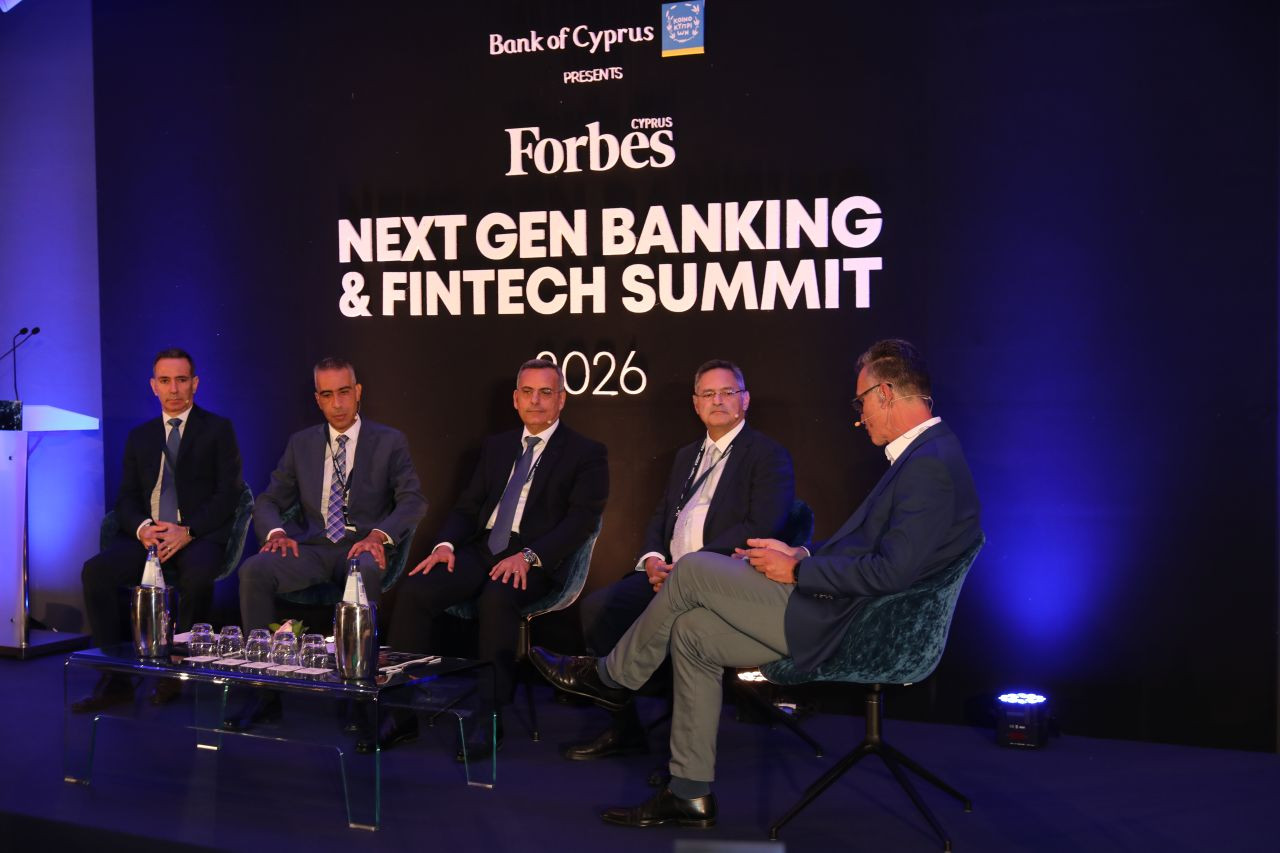
These issues were discussed at the Forbes Cyprus Next Gen Banking & Fintech Summit, held in Limassol in October 2026. Representatives of international fintech companies and Bank of Cyprus examined the prospects for digital assets, new payment methods, and the challenges facing the financial industry.
Why fintech companies choose Cyprus
Pieris Chourides, a professor at European University Cyprus, presented preliminary findings from a study of the local fintech market. According to him, Cyprus attracts companies from India and other countries thanks to its regulatory environment, skilled professionals, and the ability to use the island as a base for entering the European Union market.
Alexia Theodorou, head of Kraken’s Cyprus operations, said that clear regulatory requirements and the ability to communicate directly with supervisory authorities influenced the company’s decision to choose Cyprus for its European presence after considering several jurisdictions.
She identified tokenization as one of the promising areas of development — the representation of assets, such as shares, in digital form. The technology could potentially enable round-the-clock trading and support the creation of new financial services. However, she noted that it should only be introduced when it provides real value to customers and businesses.
Cyprus’s tourism sector may offer particular opportunities. Faster settlements, lower fees, and payment automation could make operations easier for companies serving international tourists.
Stablecoins and digital payments: what will change for businesses?
Laura Miller, Chief Revenue Officer and Global Head of E-commerce at Nuvei, believes that early expectations that cryptocurrencies would become a common payment method for almost any type of purchase were exaggerated. According to her, consumers care less about the technology behind a payment than about speed, security, and convenience. This is why contactless payments and digital wallets have become widespread: they make everyday purchases easier.
Stablecoins — digital assets whose value is tied to a particular asset, such as a traditional currency — may prove useful for international transfers and for expanding access to financial services. However, consumer protection and market accountability need to develop alongside the technology.
George Koushis, Chief Technology and Operations Officer at Bank of Cyprus, noted that traditional banks are also exploring the potential of stablecoins and tokenization. In his view, banks can combine innovative solutions with financial resources, experience operating in a regulated environment, and established customer relationships. Koushis believes that one of the main constraints for Cyprus remains the shortage of experienced professionals. The issue is not only the number of graduates, but also the ability to attract specialists capable of competing in the international market. He also called on the government to pursue a more effective policy to support the fintech sector.
Cybersecurity: responsibility remains with financial companies
Participants in a separate summit discussion stressed that outsourcing IT tasks does not release financial institutions from responsibility for security. Solon Houtris, Chief Information Security Officer at XM, noted that banks and fintech companies are becoming increasingly dependent on cloud platforms, software developers, and other technology partners. For this reason, the security of contractors should be assessed before a contract is signed and monitored throughout the entire relationship.
Companies should define responsibilities in advance, regularly assess risks, and maintain plans for dealing with disruptions. According to the expert, artificial intelligence is making cyberattacks more sophisticated and faster, which makes automated threat detection and response increasingly important.
Nicholas Kattirtzis of Odyssey Cybersecurity drew attention to the EU Digital Operational Resilience Act (DORA). It requires financial institutions not merely to restore IT systems after incidents, but to ensure continuity of critical services. In practice, management teams need to understand how long a service can remain unavailable, whether recovery timelines are realistic, and what actual system tests have shown. Written procedures alone are not enough.
Andreas Michaelides, a partner at the law firm Scordis, Papapetrou & Co LLC, added that boards of directors should be personally involved in managing cyber risks, ask questions of responsible executives, and document the decisions they make. After an attack, management’s actions before the incident may also come under scrutiny. He emphasized the importance of timely notification of the competent authorities, preservation of evidence, and review of insurance coverage.
At the same time, the claim that Cyprus legislation remains incomplete in relation to certain DORA powers and sanctions should be treated as a statement made by a summit participant. The EU regulation itself is already in force, while the Cyprus Securities and Exchange Commission publishes official materials on its application and the requirements for supervised entities.
Can Cyprus become a European fintech hub?
The summit discussions showed that Cyprus has opportunities to strengthen its position in the international financial technology market. Its advantages include EU membership, a regulated financial system, and interest from foreign companies. However, further growth will require experienced professionals, clear operating rules, effective interaction with regulators, and a high level of cybersecurity.
Costas Markides, a professor at London Business School, noted that traditional banks have so far managed to preserve their position in competition with fintech companies, but are now facing new challenges from technology firms. Banks are responding through investment in technology, partnerships, and acquisitions of fintech businesses.
For Cyprus, fintech development creates opportunities to attract international investment and create highly skilled jobs. However, sustainable growth in the sector will depend not only on the number of new companies, but also on the ability to ensure reliable digital payments, protect customers, and maintain the stable operation of financial services.