
The affordable housing project in Limassol, which for years had been described as an “imminent breakthrough,” has finally moved from the stage of promises to actual construction. After lengthy approvals, revisions of conditions, and financial pauses, the city municipality together with KOAG has begun the practical implementation of the first phase of the social housing complex. This refers to a multi-apartment building with 36 units, which is expected to become the starting point for one of the most discussed housing projects in the city’s history. This step has become an important signal for the market and residents of Limassol, who are facing an acute shortage of affordable housing and rising rental rates.
How the idea emerged and why everything was delayed
Back in 2017, amid a construction boom and the growth of high-rise projects, the need for mass social housing was first discussed at the official level in Limassol. By 2018, against the backdrop of a worsening housing crisis, the idea took on concrete form. The municipality proposed that the state allocate a large plot of municipal land so that KOAG could build affordable apartments for city residents. Already on December 11, 2018, the Ministry of Interior supported the initiative, setting an ambitious implementation deadline — by 2024.
However, reality turned out differently. Despite political support and numerous agreements, the project became a demonstrative example of how large-scale initiatives in Cyprus can stall for years due to the absence of a clear implementation mechanism.
From 700 apartments to a minimal volume
Initially, it was assumed that the allocated municipal land would allow the construction of about 700 apartments; later the figure was reduced to 600. If the project had been implemented during 2018–2020, it could have had a significant impact on the Limassol housing market. Today, amid a sharp increase in demand and prices, the first 36 apartments look more like a symbolic step. Formally, there is still talk of 600 housing units, but in reality by the end of 2027 the city will receive only 36 apartments, and by 2030 — 138.
Finances, agreements, and a new revision of conditions
Over the years, the project has been repeatedly renegotiated. In 2020, its total cost was estimated at more than 100 million euros, making it the largest social housing project in Cyprus’s history involving a municipality. In 2021, another “final” agreement was signed, providing for the distribution of housing in an 80–20% proportion between rental and purchase.
In 2023, implementation was again under threat due to a lack of funds at KOAG. The project reached Parliament, where it became clear that, apart from providing land worth 25 million euros, there was no real financing. Only after government intervention was it confirmed that the project would nevertheless continue.
New format and real figures
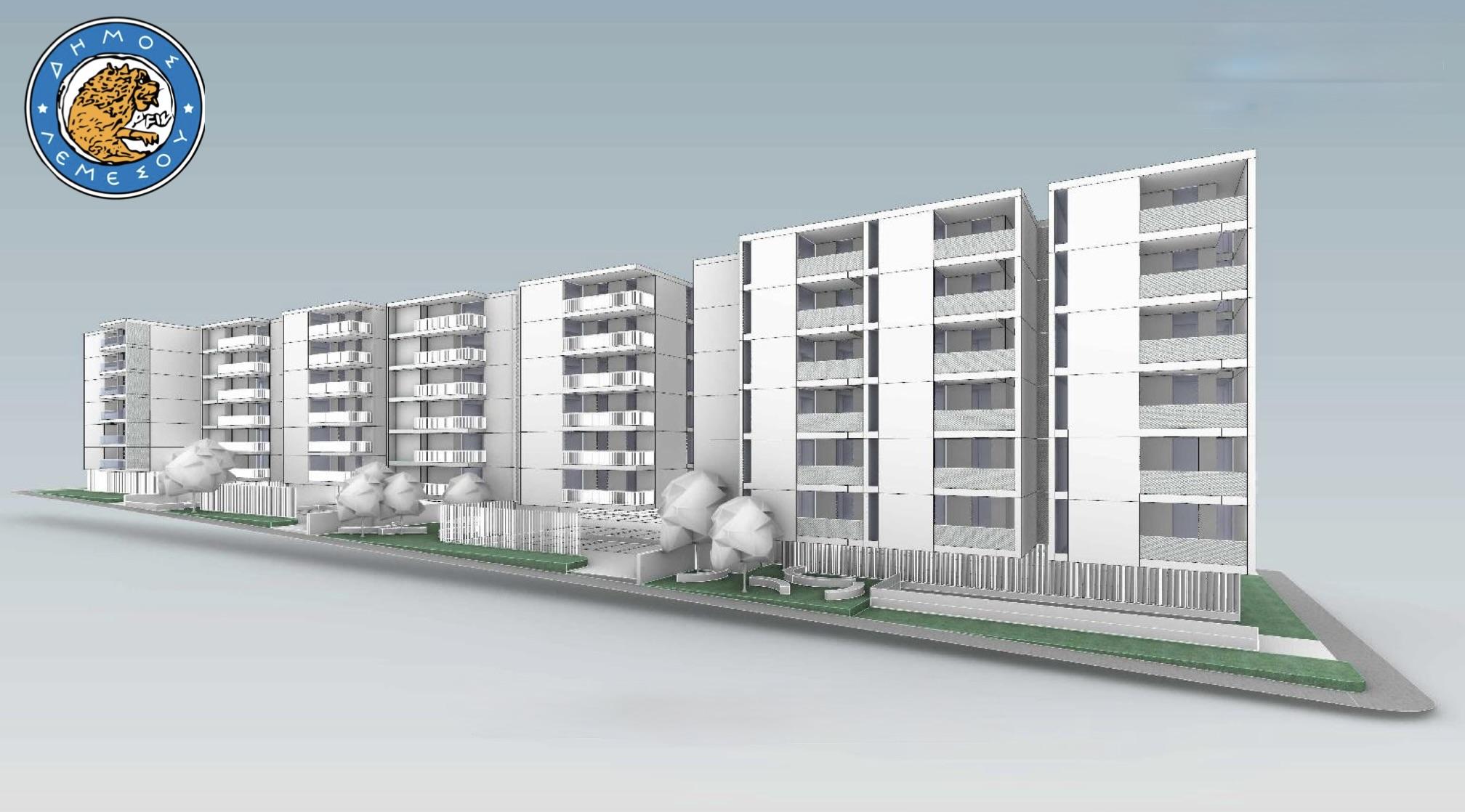
On May 21, 2025, specific and significantly smaller scales were announced. The state confirmed funding of 16 million euros, and the total budget of the first phase exceeded 22.3 million euros. Within this stage, four 6-story buildings with 138 apartments will be constructed in the Agios Nikolaos area. Construction of the first phase began in 2025, and the laying of the foundation in January 2026 became the actual start of the works.
The project includes 138 apartments: 24 with one bedroom, 72 with two bedrooms, 36 with three bedrooms, and 6 with four bedrooms. The first phase — a building with 36 apartments and underground parking — will be built over 18 months. The remaining three buildings are planned to be completed within the next 30 months, approximately by 2030. The cost of the first phase is estimated at about 25 million euros.
All apartments in the first phase will be provided exclusively in the format of affordable rental. The conditions for tenant selection will comply with the current state housing policy and KOAG criteria.
What’s next and whether the remaining phases have a future
Formally, the project is still divided into three stages. In addition to the first phase in Agios Nikolaos, there are plans for development in the Agios Ioannis area with the potential for another 180 apartments, as well as a third, largest phase of 280 apartments. However, these stages are at an early stage and currently have no clear implementation deadlines.
At the same time, KOAG has begun focusing on more compact projects that are implemented faster and already deliver results. An additional signal was the announcement by the President of Cyprus on December 9, 2025, about the launch of a new program of 500 apartments across Cyprus with a total cost of 70 million euros, also operated by KOAG.
The social housing development project in Limassol has gone from a large-scale concept to a significantly reduced but finally implementable initiative. The laying of the first stone became not just a symbol, but a real step toward solving the housing crisis, albeit on a much smaller scale than originally planned.