
The European Central Bank (ECB) has launched a public survey on the design of a new series of euro banknotes. Until September 21, 2026, anyone can choose their preferred option from 10 final proposals. Participation in the online survey is open regardless of age, citizenship or country of residence. This means that residents of Cyprus can also vote.
More than 1,200 entries were submitted to the competition by designers from across the European Union. Of these, 25 designers were invited to present their projects, and an independent jury of 21 experts selected 10 final proposals. The ECB plans to make a final decision on the design by the end of 2026. The new banknotes will not enter circulation immediately: after the design is chosen, further development, technical testing and production will be required, so several more years will pass before they are issued.
Who could appear on the new banknotes
One of the two concepts is called “European Culture”. It proposes portraits of famous Europeans on the front and scenes from Europe’s cultural and public life on the reverse. The €5 banknote could feature opera singer Maria Callas, the €10 note composer Ludwig van Beethoven, the €20 note Marie Skłodowska-Curie, the €50 note writer Miguel de Cervantes, the €100 note Leonardo da Vinci, and the €200 note writer and Nobel Peace Prize laureate Bertha von Suttner.
The reverse sides would be dedicated to corresponding cultural spaces: street performances, a music festival, a school or university, a library, museums and exhibitions, as well as a city square.
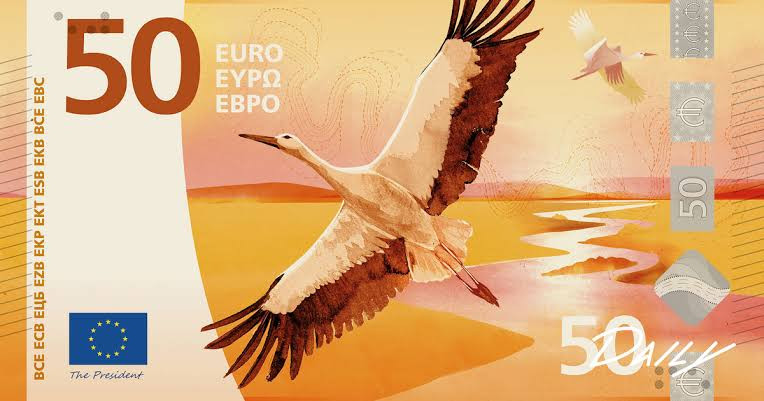
Rivers and birds instead of portraits
The second concept is “Rivers and Birds”. It showcases Europe’s natural diversity, from mountain springs to the ocean. For the €5 denomination, mountains and a wallcreeper are proposed; for €10, a waterfall and a kingfisher; for €20, a river valley and European bee-eaters; for €50, a winding river and a white stork; for €100, a river estuary and an avocet; and for €200, a seascape and a northern gannet.
The reverse sides of the banknotes in this series would feature buildings of EU institutions — the European Parliament, the European Commission, the European Central Bank, the Court of Justice of the European Union, the European Council and the European Court of Auditors.
What will change and when the new euro banknotes will appear
The upcoming update will be the first complete redesign of euro banknotes since they entered cash circulation in 2002. The ECB wants the new notes to be not only more modern, but also more secure against counterfeiting, more accessible for people with visual impairments and more environmentally friendly. At the same time, the old banknotes will not disappear immediately after the new series is introduced. They will retain their value and continue to be used alongside the new notes, after which they will gradually be withdrawn from circulation as they wear out.
For residents of Cyprus, this means that the familiar euro banknotes will not disappear in the coming years. But already now, they can influence what the future money used in Cyprus and other eurozone countries will look like.