
Paphos continues to strengthen its status as one of Cyprus’s key educational centres. One of the symbols of the city’s transformation is the new building of the School of Tourism, Hospitality and Entrepreneurship of the Cyprus University of Technology (TEPAK), which has received a prestigious international architectural award. The modern campus is not only changing the appearance of the city but also contributing to the development of higher education, research and the island’s tourism industry.
New TEPAK building recognised as one of the best architectural projects
Eraclis Papachristou Architectural Office, which designed the building of TEPAK’s School of Tourism, Hospitality and Entrepreneurship in Paphos, won first prize in the “Best Built Project” category at the Greek Architecture Awards 2026, organised by the renowned Domes magazine. Dozens of projects from Greece and Cyprus participated in the competition, with the winners selected by an international jury. The award confirms the high architectural quality of the new university complex and its compliance with international standards.
It is not only the building itself that has received high recognition. According to the international Shanghai Rankings, the school is already among the world’s leading educational institutions in the field of tourism and hospitality. The Cyprus University of Technology has also been included in the QS World University Rankings for the second consecutive year, placing it among the top 8% of the 8,808 universities included in the international assessment. This confirms the growing reputation of Cypriot higher education on the global stage.
Architecture that has become part of the city
According to architect Eraclis Papachristou, the main objective was to create not an isolated academic building but a public space organically integrated into the urban environment.
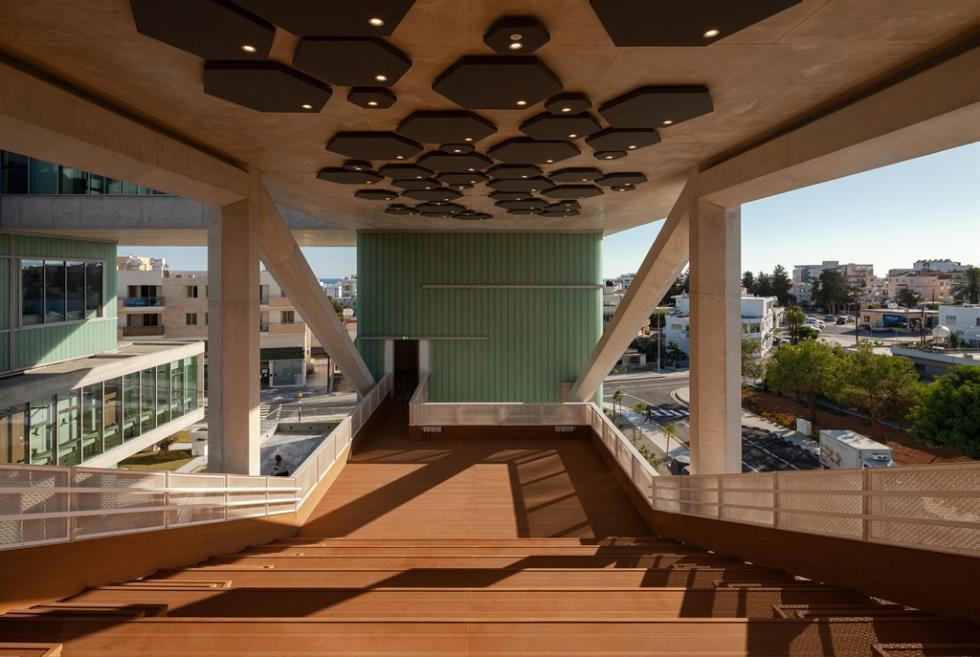
The project brings together the university complex, an existing church and new student residences, creating a unified space for interaction between students, lecturers and city residents. One of the building’s most unusual features is a large open space through which the sky literally “passes”. This design visually lightens the massive structure, makes it feel more open and fills the interior with natural light.
A wide architectural ramp leads to the main entrance, smoothly connecting the urban space with the university. As a result, the campus is perceived as a natural part of city life rather than an enclosed area.
The project incorporates the principles of bioclimatic architecture, which is particularly important for Cyprus’s hot climate. A glass envelope is installed in front of the insulated structural wall, creating an additional layer of air. This design significantly reduces heat loss in winter and prevents the interior from overheating in summer. As a result, the building benefits from maximum natural light while remaining energy-efficient and comfortable for students and lecturers. The use of such technologies is in line with Cyprus’s broader strategy to reduce energy consumption and promote sustainable construction.
A campus of the future for tourism and hospitality education
Particular attention was paid to the flexibility of the interior spaces during the design process. The building is intended not only for today’s educational programmes but also for the university’s future needs. In addition to modern classrooms and laboratories, it includes collaborative workspaces, internal plazas, an open-air amphitheatre and areas for cultural events. Students receive practical training in conditions designed to closely resemble real working environments. The building therefore includes modern training kitchens and a training restaurant, where future professionals can gain experience similar to that offered by leading hotels and restaurants. Today, the school offers a wide range of educational programmes, including:
- a Bachelor’s degree in Management;
- a Bachelor’s degree in Tourism and Hospitality Management;
- a new programme in Culinary Arts Management;
- higher diplomas in Hospitality Management and Culinary Arts, available in both Greek and English.
The development of the campus is becoming an important part of the large-scale modernisation of Paphos. In recent years, the city has been actively investing in educational infrastructure, cultural projects and scientific research, contributing to growth in student numbers, international partnerships and investment. The new TEPAK building is already being described as one of the most significant university facilities built in Cyprus in recent years.