

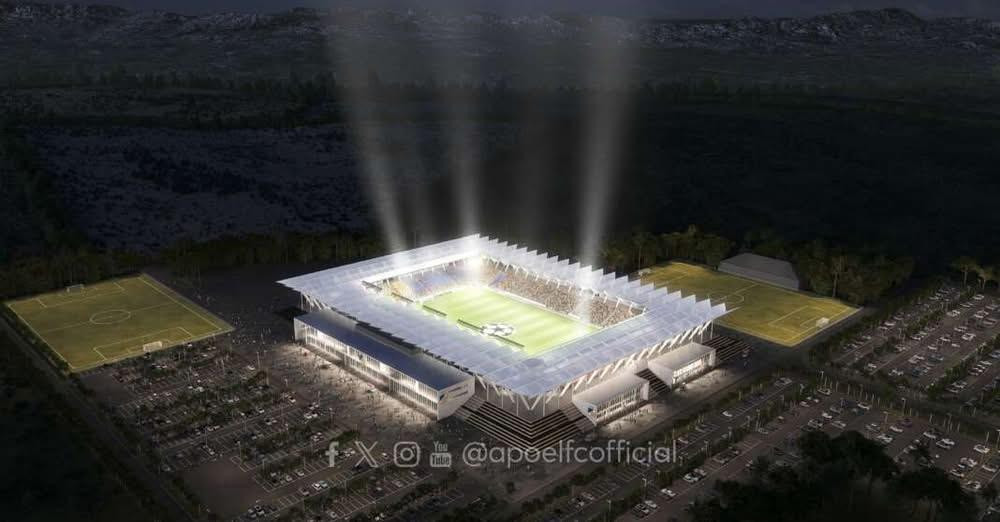
The project for a privately owned stadium for Cypriot football club APOEL has entered a new stage. On Thursday, October 15, Yellow and Blue Sports Management Ltd submitted an application for a permit to build the sports complex. The company, which is responsible for the approval process, construction, and future management of APOEL’s stadium, announced that the main preparatory work has been completed. The architectural design is ready, while the traffic and environmental studies have also been completed. In addition, the company has held all necessary consultations with the relevant government departments.
Project details
The project is being developed in cooperation with the architectural firms Chaix & Morel and J+A Philippou Architects, as well as other appointed consultants and specialists. The submission of the planning application marks an important step in the development of APOEL’s own sports complex. However, the company has not yet announced specific dates for the start of construction or completion of the project.
The project is expected to become a major architectural and engineering landmark. According to the announcement, it will be developed in two phases. The first stage will involve the construction of a stadium with an initial capacity of around 14,670 spectators. After the second stage is completed, the number of seats will increase to approximately 19,270. The new arena will also include modern infrastructure for fans, guests, and a variety of events.
It is worth noting that construction of the stadium in the Kokkinotrimithia area became possible thanks to a generous contribution from prominent businessman the late Constantinos Iordanous. He had long envisioned creating a privately owned stadium for his favorite team, and his family now intends to make that dream a reality. According to preliminary estimates, the total cost of the project will be €35 million. A significant portion of the expenses will be covered by a fund established in memory of Constantinos Iordanous, while the remaining amount will be supported through state funding for which the club is eligible.
International partners are also involved in the project. APOEL’s new stadium is intended to be more than just stands and a football field. It is envisioned as a future gathering place for supporters and a symbol of loyalty and ambition, combining modern design, comfort, and respect for football tradition.
About the football club
APOEL is one of the most popular and successful football clubs in Cyprus. The abbreviation in its name literally stands for “Athletic Football Club of Greeks of Nicosia.” The final “L” should not be confusing: Cyprus’s capital is known by two names. The city was called Nicosia by French Crusaders during the Middle Ages, while its local name, used by both Greek Cypriots and Turkish Cypriots, is Lefkosia.
In many ways, APOEL is a typical Cypriot club, with a large number of foreign players, particularly from Brazil, and an international coaching staff. The team is led by Serbian specialist Ivan Jovanović, a familiar figure in Cyprus and Greece, where he spent the second half of his playing career and much of his coaching career. The club, a 21-time champion of Cyprus, is associated with many interesting stories. For example, APOEL is the only Cypriot club to have played a full season in the Greek championship, competing in the 1973/74 season after the military coup in Cyprus and managing to avoid relegation. APOEL’s highly active and vocal supporters are also known for wearing colors different from the club’s traditional ones. APOEL normally plays in yellow and blue, but its hardcore ultras traditionally attend home matches dressed in orange. In their honor, orange became the color of the club’s away kit. The supporters are also associated not with the number 12, as is common in football, but with number 79, referring to the year in which the active fan group “Pan.Sy.Fi.” was founded.