
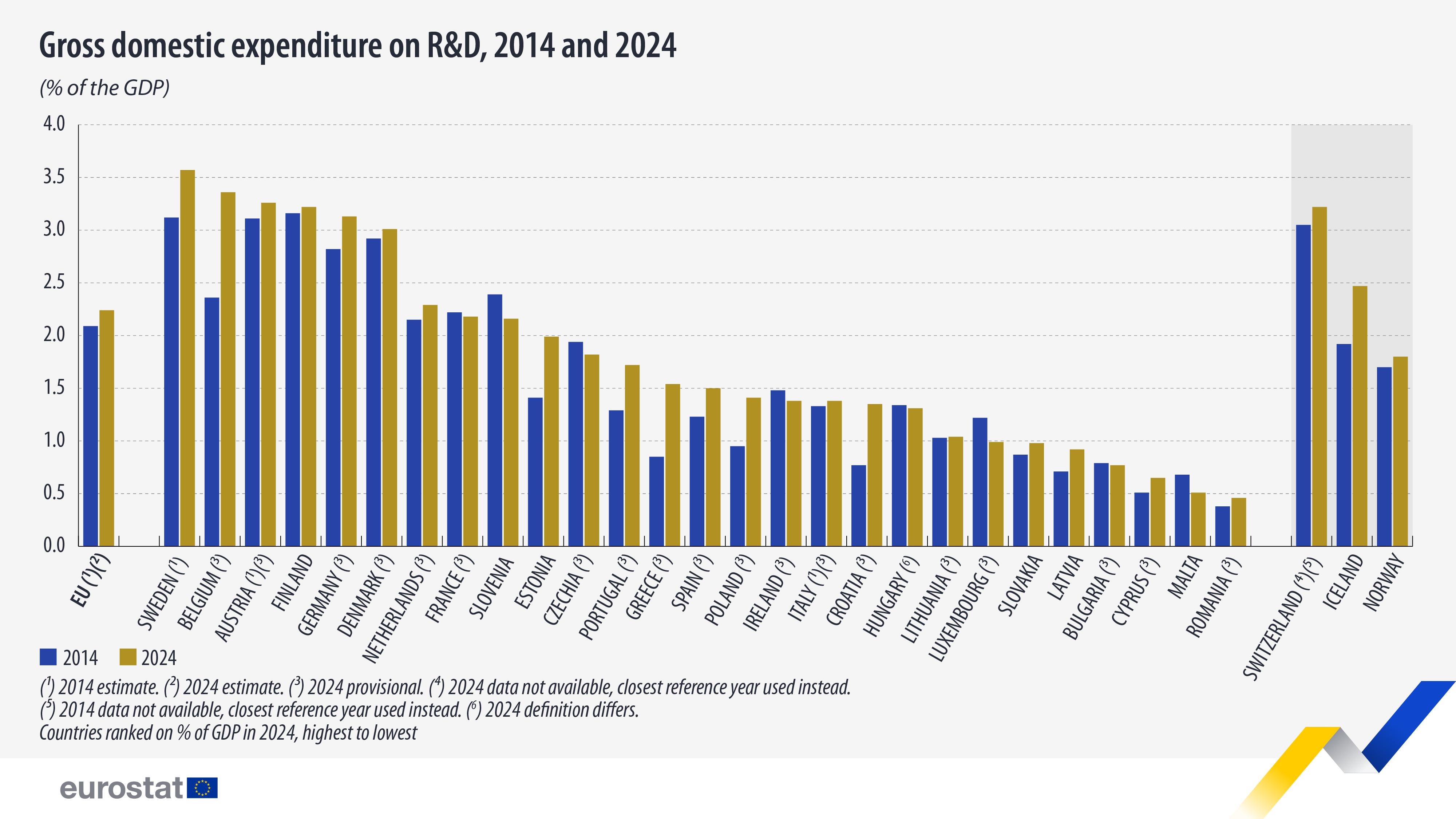
According to a new Eurostat report, total investment in research and development across EU member states reached a record €403 billion in 2024. Despite this impressive growth, Cyprus remains among the countries with the lowest spending — just 0.7% of GDP, significantly below the EU average.
This figure once again highlights a structural weakness in the Cypriot economy: a limited focus on innovation, scarce scientific resources, and insufficient private-sector involvement in developing high-tech solutions.
Europe is investing more: R&D spending has grown by over 60% in 10 years
Between 2014 and 2024, EU spending on research and innovation rose by 62%, and by 3.6% in just the past year. The intensification of investment confirms that the development of research centers, digital technologies, biomedicine, and green energy solutions remains a key priority for Brussels.
Countries such as Belgium, Greece, Estonia, and Croatia have shown significant progress — each has managed to substantially increase its share of R&D investment over the past decade. On average, R&D expenditure in the EU amounted to a stable 2.2% of GDP in 2024.
Where does Cyprus stand in the European ranking?
Six countries — Sweden, Belgium, Austria, Finland, Germany, and Denmark — have already reached or surpassed the EU’s 3% of GDP target. These states are actively developing high-tech sectors and striving for autonomy in critical fields ranging from AI to pharmacology.
Cyprus, however, is listed by Eurostat among the countries investing less than 1%. This group also includes Romania, Malta, Bulgaria, Latvia, Slovakia, and Luxembourg. For a country aiming to strengthen its position as a regional innovation hub of the Eastern Mediterranean, such a ranking is a serious warning sign.
Who invests in research: the role of the private sector
As before, private companies make the most substantial contribution to European research activity, financing around 66.5% of all R&D projects. Universities account for 21.4%, the public sector for 10.8%, and non-profit organizations for just 1.3%.
In Cyprus, private-sector engagement in research remains limited, despite the growth of the IT cluster and the expanding startup ecosystem in Nicosia, Limassol, and Larnaca. Experts note that the country needs to broaden innovation-support programs, stimulate technological investment, and improve conditions for research activity in order to reach at least the European average.
What this means for Cyprus’s future
Lagging behind in scientific investment slows the growth of Cyprus’s economic competitiveness and hinders its transition to knowledge- and technology-driven models. As competition intensifies within the EU, the country needs a more proactive R&D support strategy, including funding for universities, the creation of scientific clusters, and attracting international research centers.