
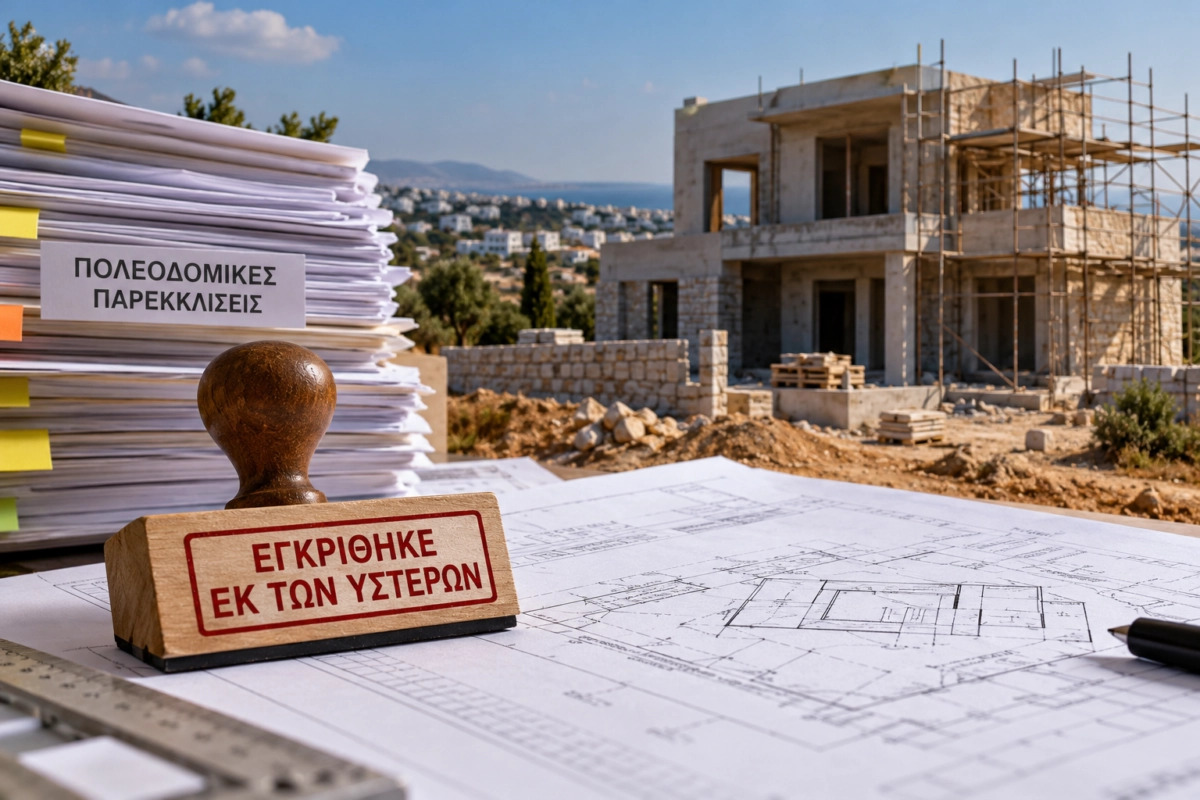
On Thursday, October 21, the Audit Office of Cyprus published a special report on the granting of building permits involving deviations from development plans. The review covered the period from 2020 to 2023. Auditors examined the records of the Council for the Study of Derogations (SYMEPA) and a sample of 17 applications. These mainly included controversial cases in which government departments disagreed or the review process was significantly delayed.
The mechanism allows projects that do not comply with existing development plans to be approved in exceptional cases. Applications are reviewed by SYMEPA, while the final decision is made by the Council of Ministers. The auditors stressed that the review was not a comprehensive survey of illegal buildings in Cyprus. Its purpose was to identify procedural weaknesses and risks related to decision-making.
How Did a Warehouse in Larnaca Become a Supermarket?
One of the most notable cases concerned a property in Larnaca’s industrial area. The premises had been approved for use as warehouses, but in practice a supermarket was operating there. Previous applications to change the use of the property had been rejected, and authorities had taken action against the owner. Despite this, the planning authority once again recommended that permission be refused. However, SYMEPA proposed granting a temporary permit for four years with no possibility of extension. The purpose was to give the business time to relocate to another property.
On July 30, 2021, the Council of Ministers approved the proposal. However, the permit was never actually issued because the owner failed to meet the financial conditions. These included a €400,000 payment to the local authorities and covering the cost of restoring a green area. According to the auditors, the supermarket was still operating when the report was published. The case illustrates one of the problems highlighted by the Audit Office: even after decisions are made and specific requirements are imposed, a property may continue operating commercially without its legal status being fully resolved.
In One Out of Seven Cases, the Council Disagreed With Planning Authorities
Between 2020 and 2023, SYMEPA disagreed with the recommendations of local planning authorities in 90 out of 627 cases reviewed. This represents 14.35% of all recommendations.
In 2023, the figure increased to 21.4%. A difference of opinion is not in itself considered a violation. However, the auditors emphasized that decisions should have clear documented justification. If the Council of Ministers reaches a different conclusion based on the same materials, the records should explain why the original assessment changed.
The auditors paid particular attention to five cases in which the council changed its position after reconsideration without documented reasons or new information. In three cases, the decision changed to a positive one, while in two it changed to a negative one. According to the auditors, the lack of transparent justification makes it harder to monitor compliance with the rules and creates risks of inconsistent decision-making.

Why Can Permit Reviews Take Years?
According to the report, between 2020 and 2023 it took an average of 25 to 31 months from the submission of an application to the issuance of a SYMEPA recommendation. The trend was as follows:
- 2020 — 31 months;
- 2023 — 25 months.
Despite the reduction in the average processing time, some applications took significantly longer. For example, a planning authority took 11 years to prepare a report on an application submitted by a private university. The Audit Office believes that delays of this kind create unequal conditions for businesses.
A company that complies with the law and waits for approval must bear costs and postpone implementation of its project. At the same time, the owner of a property built or used in violation of the rules may continue commercial activity and generate income. This creates a risk of unfair competition and reduces the effectiveness of planning enforcement.
In a response dated July 1, 2026, the chairman of the Council explained that processing time should be calculated from the moment all required reports and opinions have been received. According to him, once all documents have been collected, the procedure usually takes between two and four months. He also referred to Article 26 of the Town and Country Planning Law, which under certain conditions allows already constructed properties to be legalized. The overall duration of the process may therefore depend not only on the work of the council itself, but also on the time required by other government departments to prepare the necessary documents.
What Changes Do the Auditors Recommend?
Following the review, the Audit Office proposed improving the system for granting permits involving deviations from development plans. The main recommendations include:
- Establish clear decision-making criteria. This would make the review of applications more consistent and predictable.
- Require justification when a position changes. If the council revises an earlier recommendation, the reasons should be documented.
- Make compensatory measures transparent. The calculation of financial obligations and other conditions should be clear and properly justified.
- Introduce a unified application monitoring system. Case tracking and deadline control should be improved at every stage of the review process.
The report did not identify evidence of an actual conflict of interest involving members of SYMEPA.