
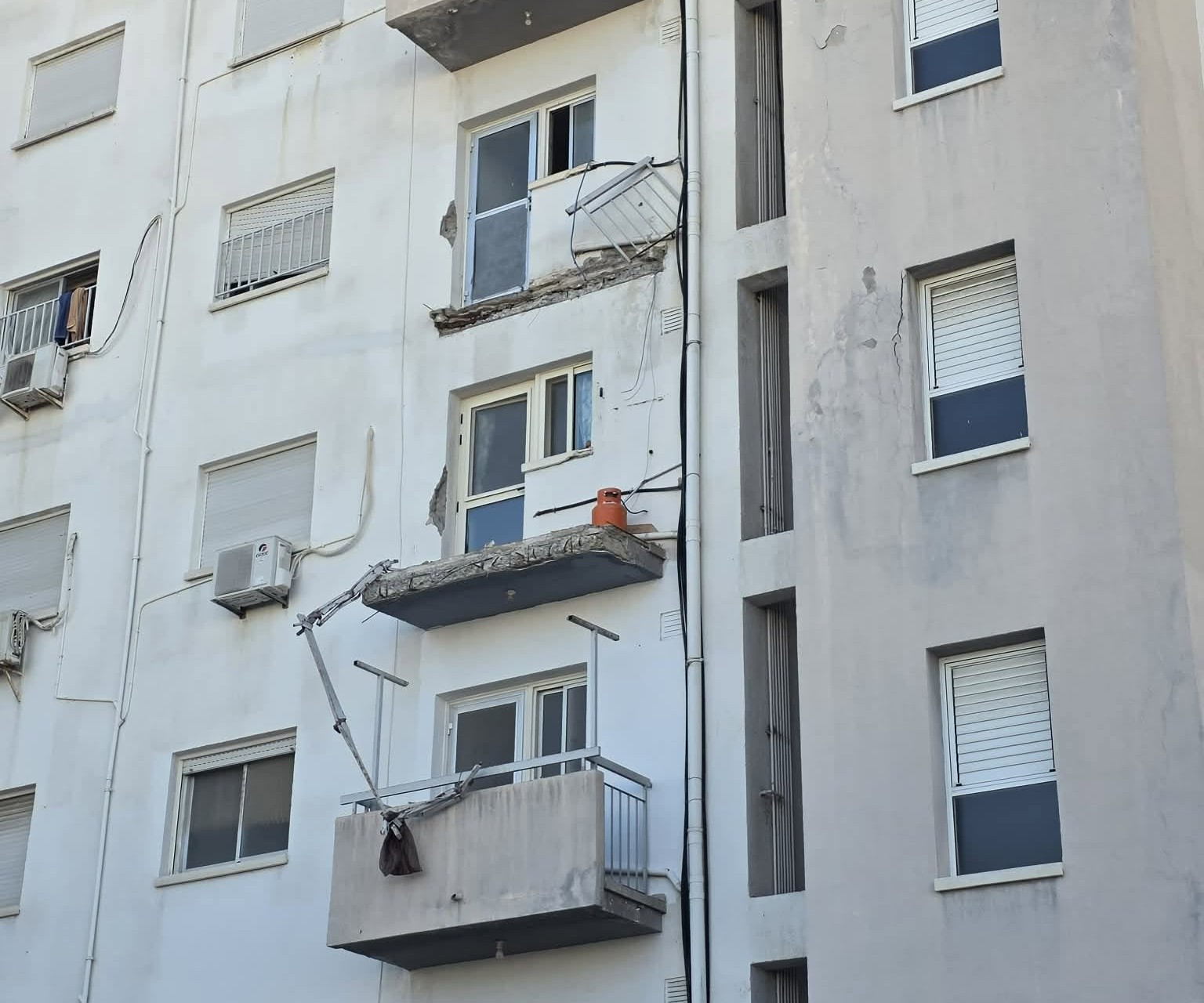
On Monday evening, June 29, a serious incident occurred in the Kapsalos area of Limassol, once again drawing attention to the condition of Cyprus' aging residential buildings. Two balconies collapsed simultaneously in a seven-storey apartment building, with debris falling onto a parked car. Fortunately, no one was injured. As a precaution, the authorities immediately evacuated all residents, with 35 families temporarily leaving their apartments.
What happened at the apartment building in Limassol
According to the Cyprus Fire Service, sections of the balconies on the third and fourth floors collapsed. The falling debris severely damaged a car parked beneath the building.
Firefighters, police officers, officials from the Limassol District Local Government Organisation, and members of the Civil Defence responded to the scene. The area surrounding the building was quickly cordoned off to eliminate the risk of further collapses. Fire Service spokesperson Andreas Kettis confirmed that, fortunately, there were no casualties or injuries.
Following a preliminary inspection, the Chairman of the Limassol District Local Government Organisation, Yiannis Tsoloftas, ordered the complete evacuation of the building until a full structural assessment is completed. Temporary accommodation has been provided for the displaced residents while engineers examine the building. Residents will only be allowed to return once specialists officially declare the structure safe. Engineers will inspect the load-bearing elements, balcony slabs, reinforced concrete frame, and façades. If significant structural damage is identified, the building may require major repairs or reinforcement.
Limassol's aging apartment buildings are becoming increasingly dangerous
The incident in Kapsalos has once again highlighted one of Cyprus' most serious challenges — the rapid ageing of apartment buildings, most of which were constructed during the 1970s and 1980s. In coastal cities such as Limassol, the situation is made worse by the marine environment. Salt-laden air gradually penetrates concrete, causing corrosion of the steel reinforcement inside. As the steel rusts, it expands, cracking the concrete from within. This is why balconies are considered among the most vulnerable parts of older buildings.
Engineers note that many residential buildings have gone decades without major maintenance, while regular structural inspections of apartment buildings are still not mandatory in Cyprus. As a result, hidden defects are often discovered only after visible cracks appear or parts of the structure begin to fail.
According to the District Local Government Organisations, following the recent administrative reform they assumed responsibility for a list of 1,287 potentially dangerous buildings across the island. The highest concentrations are in Limassol and Nicosia, although experts acknowledge that the actual number of unsafe buildings is considerably higher. Local authorities have repeatedly stated that the current legal framework does not allow them to intervene quickly in such situations. Municipalities also face significant funding shortages for large-scale inspections and emergency repair works. The Cyprus Scientific and Technical Chamber (ETEK) has for several years been calling for the creation of a national register of building conditions together with mandatory periodic inspections of apartment buildings, particularly those located in coastal areas.
What changes are the authorities preparing?
Following several serious incidents, including the fatal collapse of a building in Limassol that claimed two lives, the government has begun preparing legislative changes.
Parliament is currently considering amendments that would significantly expand the powers of local authorities. The proposed legislation would simplify procedures for declaring buildings unsafe, accelerate the evacuation process, permit the compulsory closure of dangerous properties, and allow temporary disconnection of utility services where there is an immediate threat to life. Lawmakers are also discussing substantially higher fines for property owners who fail to comply with orders to repair hazardous structural defects. At the same time, ETEK continues developing a digital platform that will publish information on the technical condition of unsafe buildings. The registry is expected to improve transparency in the real estate market and enable buyers to assess potential risks before purchasing a property.
The Kapsalos incident serves as another reminder of the importance of timely maintenance of apartment buildings. According to engineers, regular inspections, façade repairs, and proper protection of reinforced concrete structures can significantly extend a building's lifespan and help prevent similar incidents. Against the backdrop of Cyprus' ongoing construction boom, the safety of the country's ageing housing stock is becoming one of the key issues in urban policy. Experts warn that without a comprehensive modernisation programme and mandatory structural inspections, the number of such incidents could continue to rise in the coming years.